
Awakening the beast a.k.a. the good-Natured Beast
PRESERVE – Call for Attention, a piece choreographed by Rotem Weissman with Susanna Ylikoski as a co-creator, was performed at DOCK 11 from 25 – 27 September 2026.
– Text by Anuya Rane
Leaving the theatre after witnessing the performance, I was left feeling charged, albeit somewhat exhausted. In an attempt to decipher the contradiction in the aesthetic experience, I take up the task of revisiting the performance in my cognitive space to put words to the perception.
The title in itself is a clear indication that through this piece the artists are calling out for attention to preserve. It is – as they frame it, “a choreographic exploration that draws an analogy between the decay of nature and the decay of human society.” This call for attention addressed to a “boneless society” serves as the backbone of the narrative while the performers glide effortlessly through the avenues of transformation and decomposition.
they scurried, and they scuttled,
and they looped, and they lurched,
and they humped, and they stretched,
they slid, they hissed,
and sucked up the nectar…
(of) Mother Nature
made them be
made them become
of Earth
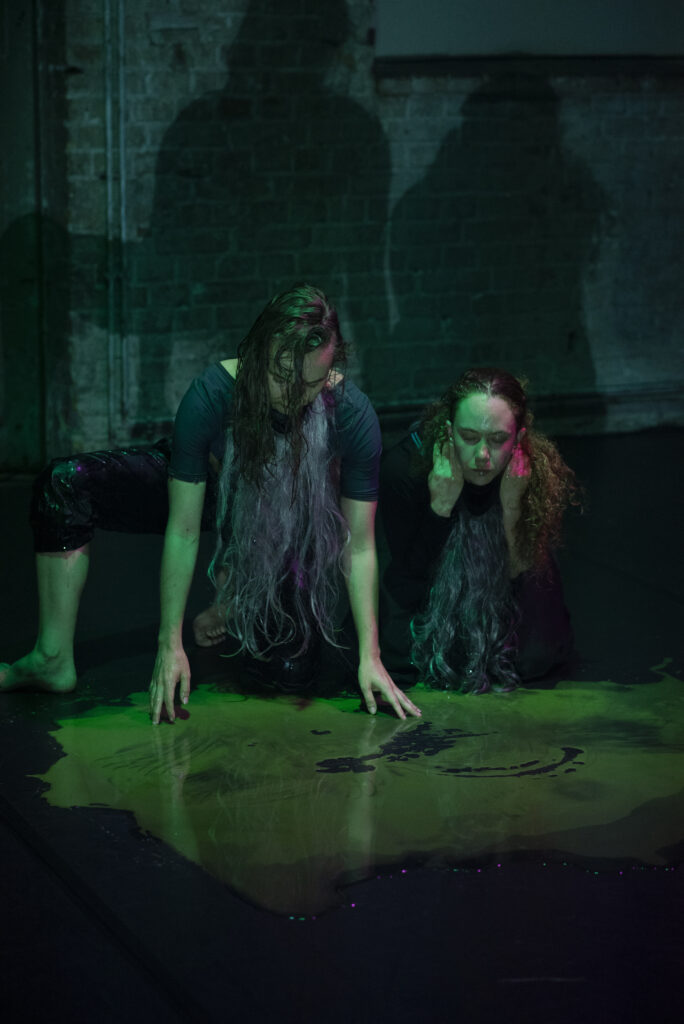
Right from the moment we entered the theatre, we were as if taken to a deep cavern where all worlds seemed to merge. The soundscape and the lighting bore the responsibility to make this experience tangible. The two performers, Rotem and Susanna, engaged in minimalistic movements advancing at a slow pace as the evening opened. One moved, while the other, resting her head on the one moving, was dragged along. At this stage already, the costumes grabbed my attention. They were simple, suggesting rawness, although not being made of any specific natural textures or special designs. They enhanced the moving bodies and added a texture to their appearance. The holes and cuts on them exposed some parts of their bodies and skin, providing a disguised look whenever the two bodies mingled and fused. The costume designer Han Lai chose an apt colour palette using earthy tones.
On one side of the stage towards the rear, a green wet patch made itself visible. This certainly was some kind of liquid, but it maintained its pre-designed shape and threshold rather than flow all over the open floor.
Having covered almost half of the stage, this twin entity split into two separate units. The two performers emerged in their individual forms and began moving or rather dancing. The movements were nothing less than a dance that embodied nature in its myriad forms. Were they trees or plants? Were they vertebrates or invertebrates? Were they humans or animals? They achieved a state – formless, nameless – ruling out any segregation, denying all possibilities of a human – animal divide.
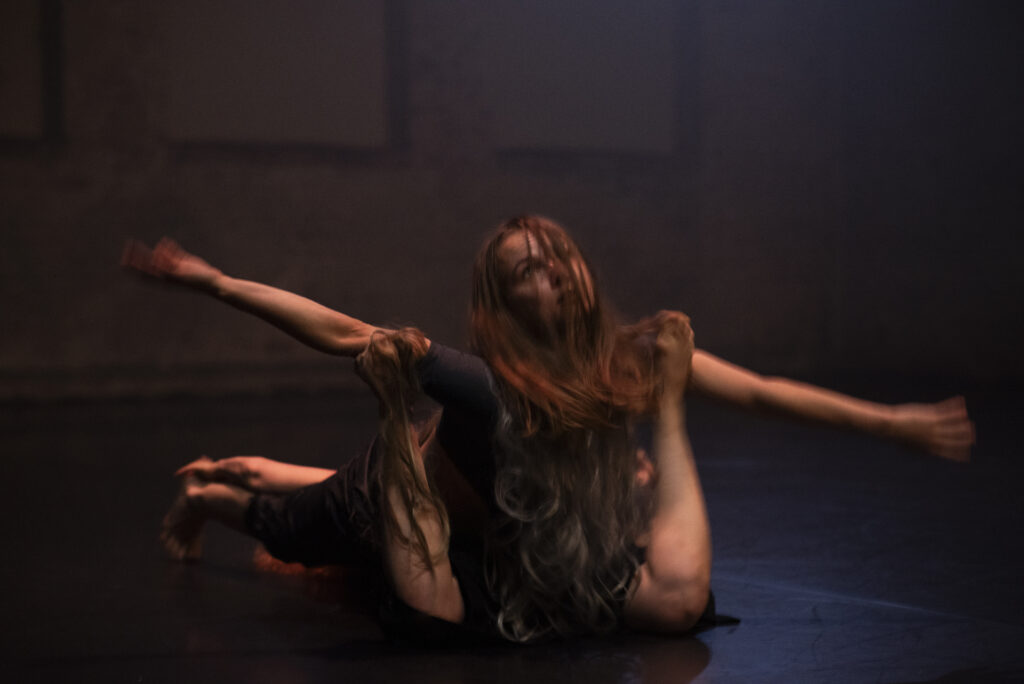
All of us living things fall under the umbrella of biodiversity, subdivided into genetic diversity, species diversity and ecosystem diversity. These human-defined scientific classifications bring us closer to the understanding of differences in genes and DNA, distinction between species and the variety of different habitats. At the bottom of these divisions lies the fact that all biological entities as living organisms interact with each other to make a complex eco system; Nature, the term that embraces us all and suggests oneness. Watching the two performers merge, co-exist and reciprocate, I got absorbed in their breathing, their heart beats, their motion and felt one with them and the atmosphere as a component of that one big world. It was to me a perfect artistic utopian illusion.
As it happens human beings interestingly tend to perceive the world as humans vs nature or humans and nature or if I may dare be more precise, humans against nature rather than think human beings and the broader environment. Where does this idea of separation stem from? I have always pondered over this ideology.
The scientists certainly have an answer or engage in continuous debate over the roles of each element if not the mere affirmation of the human superiority to the other speechless (speech as language and words, outlined by humans) natural world. This performance touches upon the decline of the global eco system which partially is human driven. An almost incurable climate catastrophe as humans continue to overexploit earth’s natural resources.
As a prop the dancers introduced a leaf blower, running it over and around their bodies and in the space while sometimes sucking in hair and arms creating an impression of distortion. This is our decaying society, decaying humanity, resulting in the decay of nature. Recently, I came across the term “renaturing”. It is just an extension of recovering and flourishing nature. I would associate the term with the suggestive deformation or perhaps a metamorphosis of shapes and forms created by the dancers.
Going beyond the recovery of nature through its own means, there is a chance for humans to renature by planting, nurturing, cultivating new green spaces wherever and to whomsoever possible. It’s a shared responsibility for all humans towards building an eco-citizenship. Born with an environmental awareness, we have developed a tendency to neglect it while prioritizing other material needs. Unfortunately, we still require constant reminders of the ongoing crisis. Therefore, the cry from the creators of this creative endeavor.
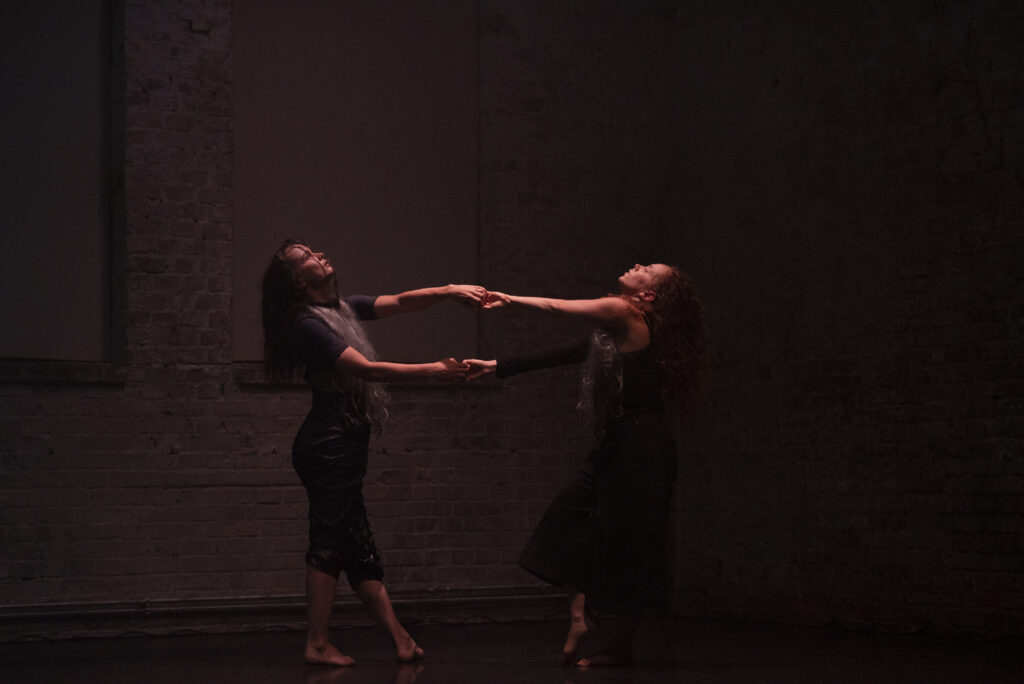
Besides the dancers’ limbs, the music proved to be another inseparable limb of this choreographed body. It was composed – by Roi Becker and Cesar B – in a way as to accompany the cry by creating sounds that resonated inside each body present in the space. The ethereal, multilayered composition made flora and fauna appear on an otherwise bare stage. They were sounds of nature in anguish to speak to us. It’s nearly impossible to imagine this performance without this music given the character and emotions it provided for the movements.
Towards the end of the performance, the dancers confronted the green liquid on the floor and played with it. They rubbed it on their bodies and hair and spread themselves in it; going back to where we came from, synching in, becoming one with nature. They gyrated in a trance as if possessed by the spirit of nature urging us to recognize our interconnectedness with it. That we are trapped in an environmental emergency is indubitable. Despite our continuous action, we are already in decay which is independently more strongly in action. While dealing with a sensitive topic the performance did not make promise, nor did it discourage. It simply unfolded a harsh reality. With the rawness and beauty that they presented it – which gave me the aesthetic experience – it galvanized and encouraged all to reevaluate our participation in environmental sustainability.