
A Watercolor in Motion
JUA KALI
by jared ONYANGO & Lea Pischke
at KUYUM Tanzplattform, Berlin
19 September 2026
– Text by Boda Keem
Let’s split into two groups! JUA KALI begins by casually dividing the gathered audience into two groups. Following the two performers at a slight distance from one another, we turned around at the theatre door and stepped out of Uferstudios. It didn’t take long for the performer leading my group to set off at an even pace: a stride neither short nor wide, an upright body, upper arms almost still, and a gaze that repeatedly turned back to check that his little group was still with him. As the street grew crowded, he cut across it, taking a shortcut; across Badstraße, I could see the other group moving along. We had arrived as a loose gathering of strangers, brought together simply to see this performance, but somewhere along the walk we began to feel like a single brushstroke moving through the city at a different speed from the pedestrians around us.
At U8 Pankstraße, the woman walking just ahead of me held the elevator door open. It was the first time I saw her face. As we came out of the station elevator, a man walking toward us from the opposite platform glanced at our group and said, Let’s go vote tomorrow. When we asked who he would vote for, his answer was simply, working class. Only then did I notice the shoulder carrying his old backpack slip neatly into the closing elevator doors. He began walking again, and we returned to the theatre, leaving the golden-hour city behind us and sharing the short, steady steps of the walk. Before we could look at bodies from another city, we were already walking through the rhythm of one city.
When we sat back down in the theatre, we were no longer neutral observers. The Berlin streets we had just walked through had done more than take us from one place to another; they had already inscribed in our bodies whom to follow, where to avoid, when to stop, and when to move again. But the path we had taken was never simply a predetermined route. At U8 Pankstraße, we had stopped to exchange a few words with a man who happened to cross our path; a route can be interrupted by an unexpected encounter, then continue again in a new direction. A path is not a line drawn in advance on a map, but a trace continually made as people walk, avoid, cross, and pause. Having followed such a path back into the theatre, we were now watching bodies living in another city. Yet the bodies doing the watching had already been shaped by the city we had just walked through. At this point, JUA KALI does not try to erase the distance between the audience and the bodies onstage; instead, it first makes visible how that distance came to exist.
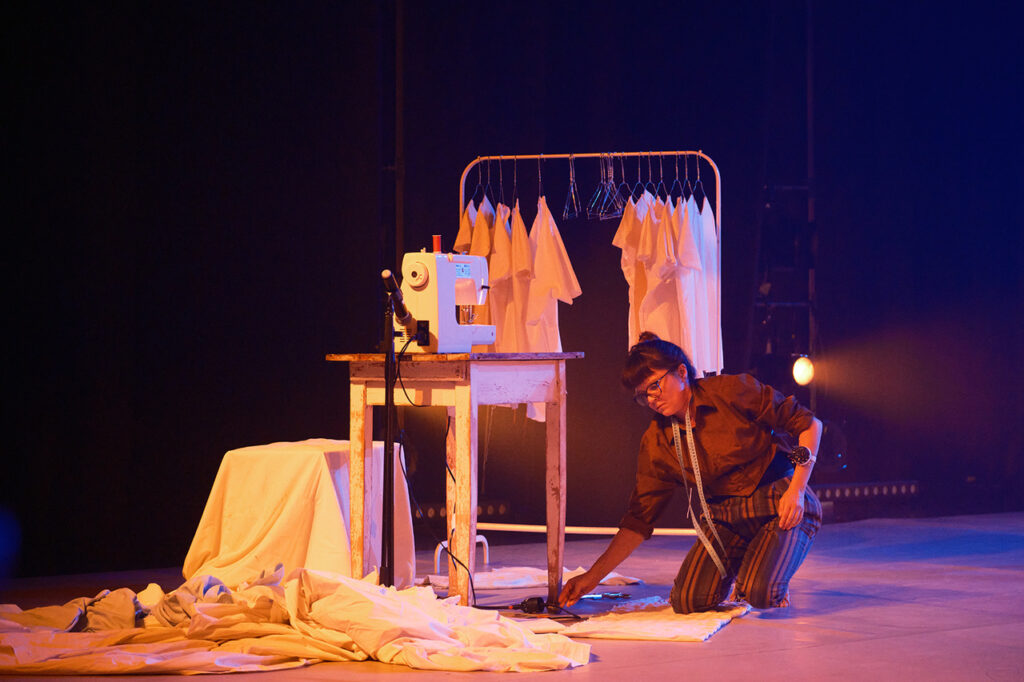
The theatre doors opened – the first thing I noticed was a strip of white fabric running along the passage toward the stage. It was tangled into a heap of cloth, as if continuously pushed out by an unseen mechanism, one end feeding endlessly from beneath a running sewing machine. A woman with glasses perched low on her nose guided the fabric beneath the needle. There was no slack in her movement, no wasted gesture, only a tight, unbroken rhythm.Yet the sewing machine itself was almost impossible to hear beneath the sound filling the theatre. It was hard to tell whether it was a train or a factory, but it sounded unmistakably like a massive machine locking into motion all at once. Every so often, a man’s voice cut through it from somewhere in the distance – half shout, half chant. Three dancers moved across the crowded stage, where there seemed to be barely enough space for another piece of fabric. Their arms extended in straight lines as they walked quickly, tracing right angles through the space. Whenever a strip of white fabric came close to their feet, they sharply changed direction. No one met anyone else’s eyes. Then, suddenly, the sound stopped. In the silence, the sewing machine and the dancers’ footsteps rose to the surface. The needle pushing through fabric and the feet pushing against the floor began to produce the same repetition. Thud, thud, thud. Walking was no longer simply a way of getting somewhere; it had become a continuous act of pushing against, avoiding, and moving through something. The movement began to feel like a watercolor of a city I had never visited.
The light shifted slowly. The watercolor landscape moved from day into dawn, then into an intimate space where the sun seemed to rise from within it. Jack Bryton, who had led us through the streets outside Uferstudios, slowly entered the stage and began to walk again. It was a different body from the one I had seen outside. His steps no longer belonged to the cityscape; they belonged to the private movement of a person held within it. Not another color in the landscape, but a human body. From there, a series of short solos passed through the stage.
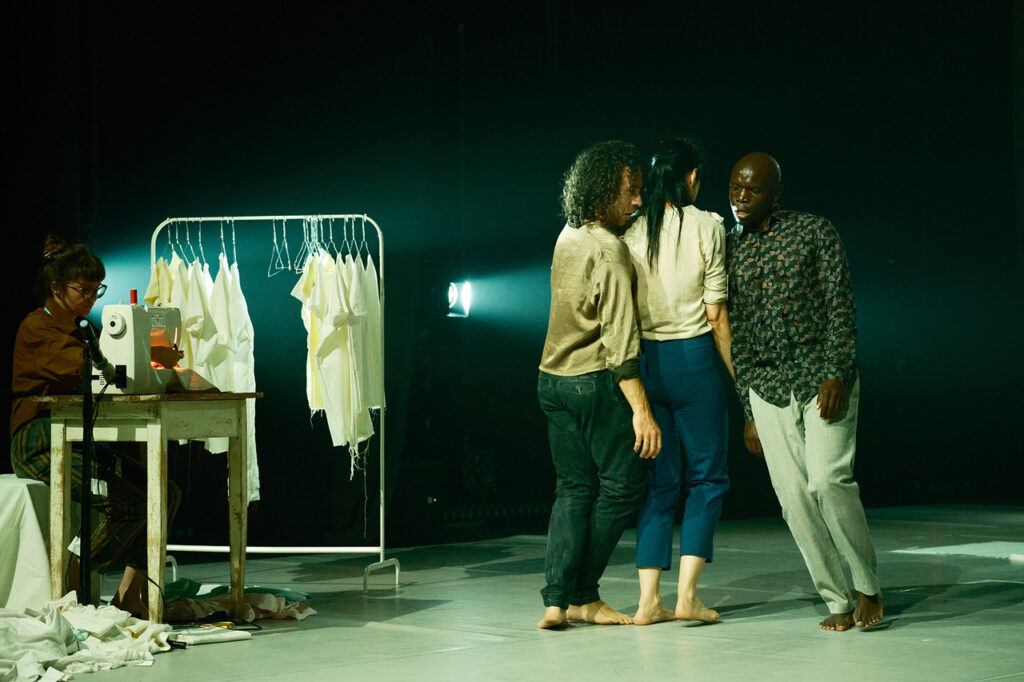
As the other dancers joined one by one, the texture of walking began to shift for the first time. The quick, linear crossings softened into arcs, and instead of avoiding the white fabric on the floor, the dancers began to leap over it lightly, sometimes suspended in the air for a long beat, with an almost mischievous ease. Their eyes began to meet. The choreography now depended on reading where another body was headed, when it would stop, and when it would move again. If the bodies at first had read the obstacles of the space to find a path, they now read one another to make one. The body that had been responding to its environment began to respond to other bodies, and the path shifted from a physical route into a relational structure. Walking was no longer only a form of labor – making one’s way through given conditions – but a form of play, a way of building a shared route through attention and response.
In between, the woman at the sewing machine removed pieces of white fabric from the floor and carried them back to her worktable, yet the material conditions of the stage barely changed. The fabric, the stage, the easels at the back- all remained where they were. What changed was the relationship between the bodies, and suddenly the same space began to unfold as somewhere else. The white fabric, which moments before had been an obstacle to avoid, now resembled something from a children’s game, an obstacle to leap over as if the floor had become lava. The dancers watched one another, stopping and running, and a different kind of tension emerged: playful, alert, slightly mischievous. The play gradually shifted from the energy of children to the loose, unhurried play of adults sharing an open afternoon. Nothing material had changed onstage, but as the relationships between the bodies changed, so did the character of the space.
In that moment, I thought of watercolor. Rather than reproducing the streets or architecture of a city I had never visited, the work allowed light, bodies, and fabric to overlap and form a landscape of their own. The paths traced by each body never remained as independent lines; they kept changing direction, overlapping, and disappearing as they met the movement of other bodies. What made it look like a watercolor was not the beauty of the movement, but the way one path kept changing form as it met another. The city itself was never reproduced onstage, yet the ways people occupy space – walking, avoiding, meeting, playing – were translated into layers of bodies, light, and sound. Different lines from the paths I had walked through Berlin were now moving across the stage. The choreography produced by Nairobi as a place was being reconfigured before me through the dancers’ bodies. Everyday movements and the act of walking through streets expanded beyond simple movement or labor into a relationship between bodies negotiating how to occupy a city and each other’s space. It felt as though the invisible exchange between city and body had been carried all the way to the distant Berlin where I was standing.
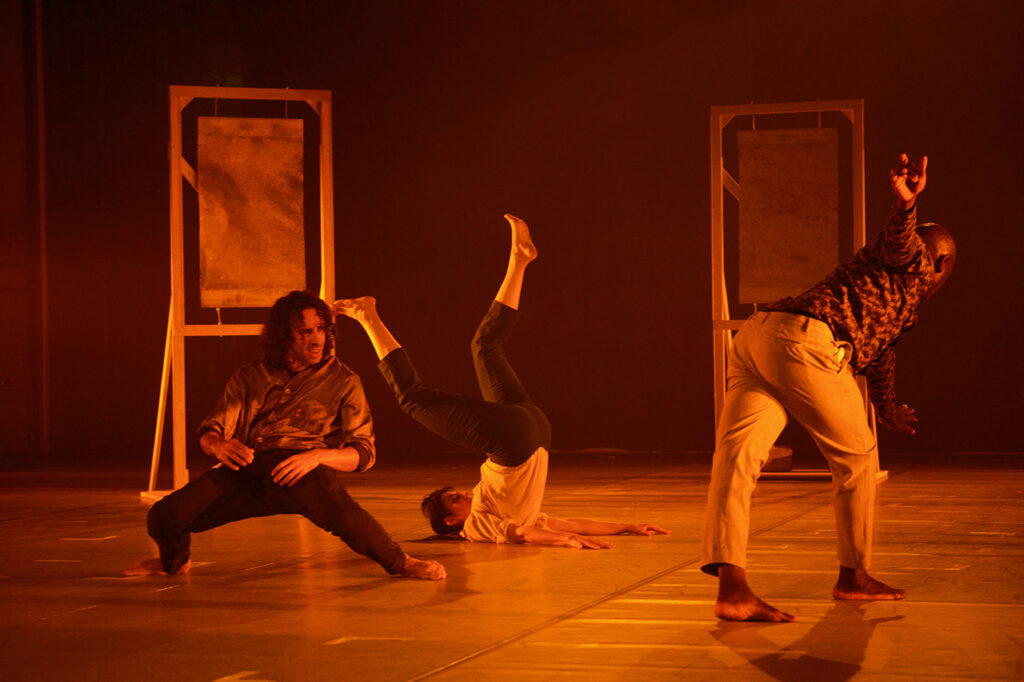
Then the easels at the back of the stage began to move forward. The dancers lifted them to waist height, turned them around, and tapped their silver surfaces with their heels, each at their own pace. The feet that had earlier crossed the stage to make paths were now leaving traces and sounds on a single surface. The city gives the body paths, but the body does not simply follow them. It avoids, detours, stops, and meets, rewriting the path as it moves. In the end, that rewritten path remains as both sound and material trace.
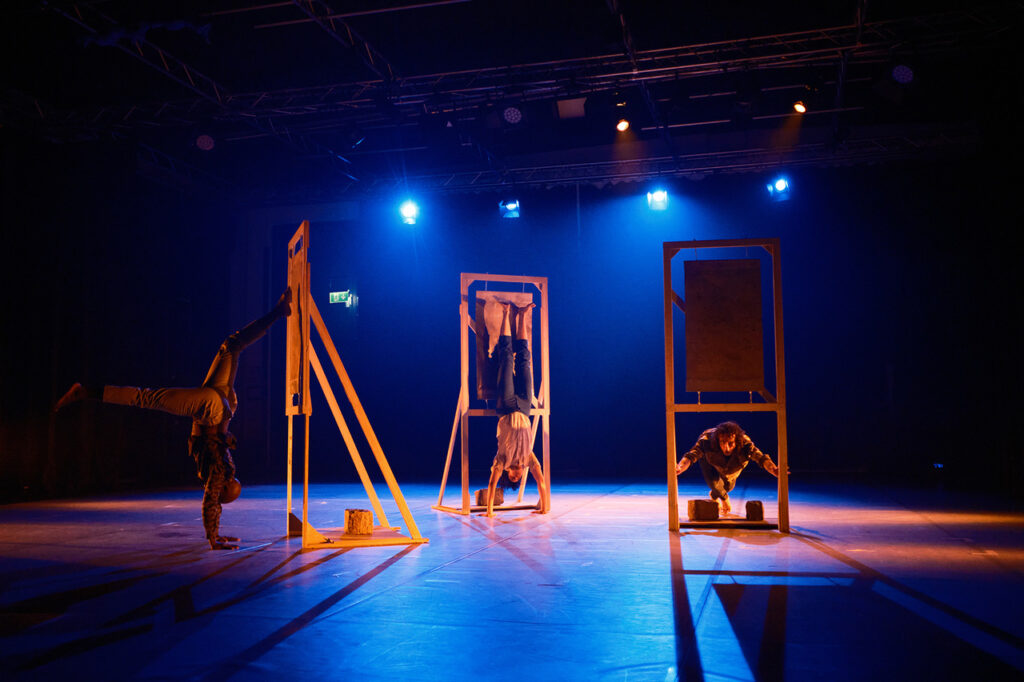
The easels, now brought back onto the stage, were no longer tools for making images. The dancers tapped their surfaces at different speeds, leaving behind the paths and rhythms they had traced across the stage as a physical residue. In JUA KALI, walking is not simply a way of moving from one place to another. It is a way of making a path within given conditions – avoiding, occupying, meeting, and moving again, the watercolor in motion.