
Megumi Eda: To show or not to show… what if that was the question!
On 4th of June 2026, Megumi Eda premiered her new work, “Yoridokoro – Silent Anchor” at Dock11. The following text is about my reflections on the performance.
There are
Spaces within me
Spaces outside of me
Spaces around me
And I organically oscillate
Between spaces
Spaces that integrate me
Spaces that I make my own
By creating them safely
Wherein I exist
Megumi describes “Yoridokoro” as being an autobiographical work. She writes; “this work explores the Japanese concept of kokoro no yoridokoro—a place of grounding or return—through the relationship between body, space, and sound, asking what it means to exist”. There is a side to her existence that she has never disclosed publicly. Venturing into that zone, letting it gradually unfold in front of the audience is a challenge for her sense of safe place. In her quest to dig and find, she seems to be dwelling in this dual reality of what she is capable of and what eludes her. She wants to challenge her trusted ground. Why would she want to do that?
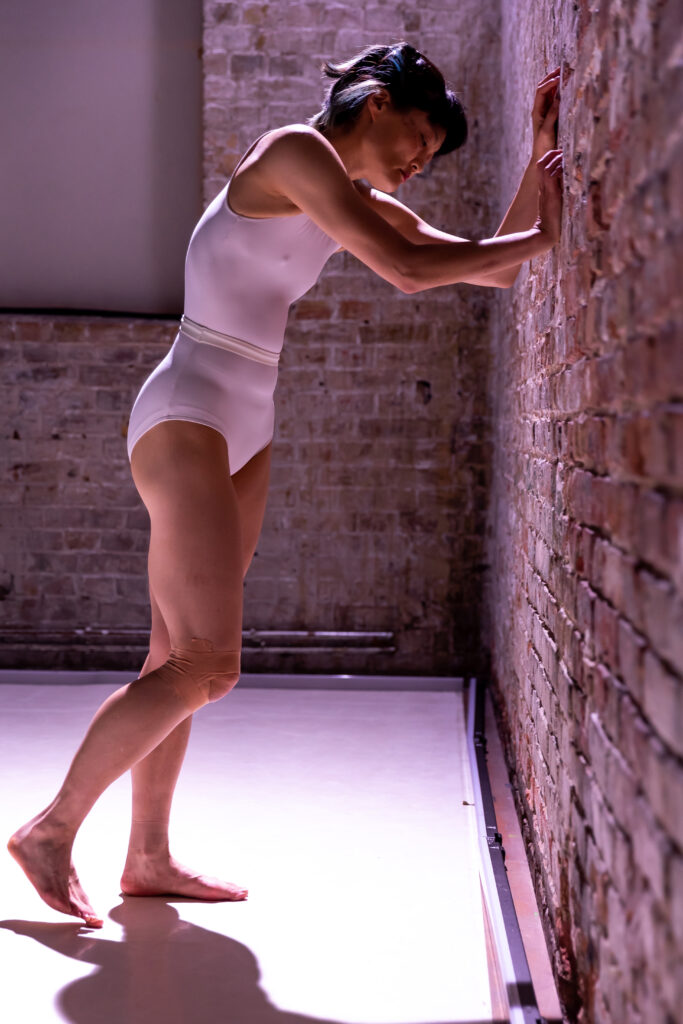
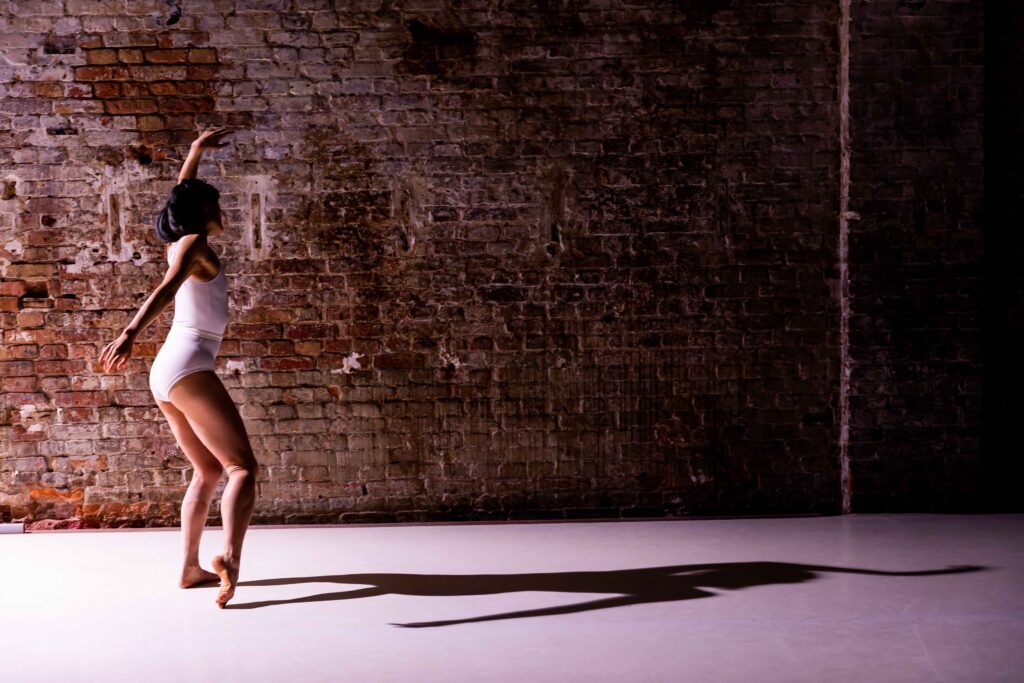
As she opens the performance, she is lying in the centre of Dock11’s wide, open, white stage on a red piece of cloth spread out in a circle. It creates a serene atmosphere. From that position she slowly starts moving and blooms into her dancer self. Eda is an accomplished ballerina with an extensive experience of performing in all the major classical ballet repertoires. However, she is here to take us into her secret world of sensations and memories. Memories of struggle to master a technique that has undoubtedly embellished her achievements. For a ballet dancer and a person with an Asian background, constant societal pressure to prove oneself, to deliver perfectly what is expected, is a given. Discipline, social rules and regulations are integral to daily life and deeply anchored in the subconscious mind. Megumi attempts to tap into that subconscious, imagining new limits of oneself, and – in doing so – inadvertently opens a terrain full of questions, questions that have long been hiding underneath.
The performance continues with a pre-recorded video call with her composer Reiko Yamada projected onto the rear wall of the theatre. Both are in their private rooms attempting to play volleyball with each other – with an imaginary ball. More than a game this seems to be a volleyball lesson for Megumi who is having trouble with the serve. While their virtual playing continues, the “physical” Megumi disappears from the stage.
Next, she returns clad in sports gear (jersey, shorts, trainers) and a volleyball in her hands. Begins running (backwards) in a circle holding the ball with both her hands, counting – at times almost breathlessly – and checking the minutes with Reiko (seated with her equipment in line with the audience). She manages eight minutes – a goal supposedly set for her in her early years – a memory still haunting her. Suddenly she starts tossing the ball to begin a volleyball match. She fools around recklessly with the ball by launching it in all directions, including the corner where Reiko is seated with her laptop. The audience collectively held their breath for a quick moment, when – fortunately – the ball missed the laptop. Reiko joins her in the play which ultimately ends with the audience’s participation.
What a smart decision, I thought, from a choreographic point of view, to involve the audience and make them a part of the game and share the responsibility with them to make it work. Through these antics – which also includes a perfect execution of an effortless-looking développé while failing multiple times in achieving it perfectly – she is not shying away from exposing her short-comings. The fact that she is the choreographer and performer herself gives her that extra leverage to strike a balance between conceptualisation and rendition.
The objects used throughout the performance, such as the ball or the swirly red dress (the red piece of cloth lying on the floor at the beginning) that she is dressed in towards the end of the show, are not only used for their basic function but also serve as a symbol of an endless cycle of action and reaction, trial and error, losing and achieving.
The space she is in becomes circular, blurring lines between silence, music, stillness, performer, musician and the audience. The unspoken emotions that she intended to address find their voice in the piece. She has the strings attached to her inner world, and to me, it seemed as if she succeeded perfectly in choosing which strings she wants to loosen, when and how.