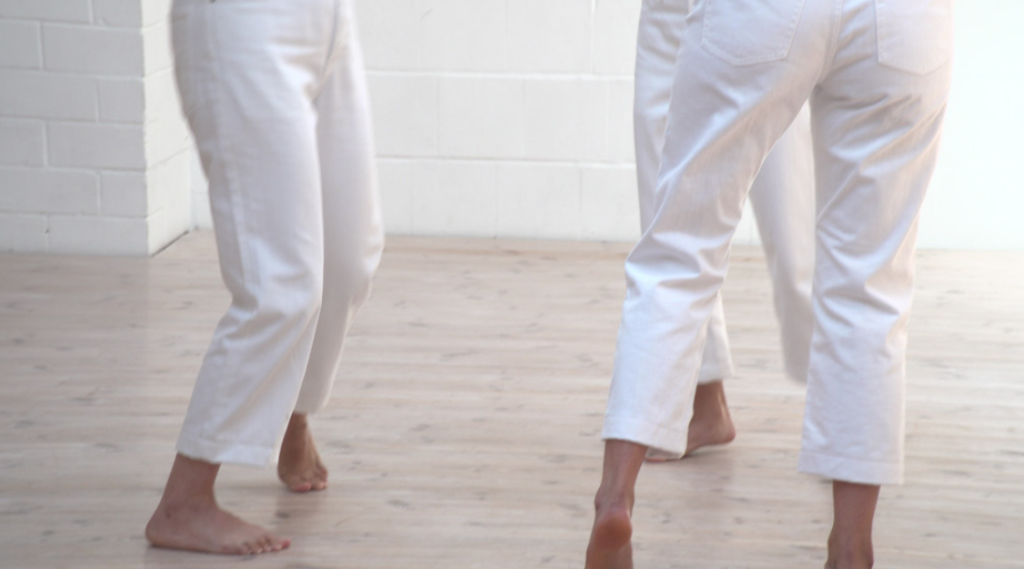
Sasha Amaya: The Orfeo Project
Nicola van Straaten speaks with choreographer and director Sasha Amaya about her choreo-operatic research project. – May 2023
I didn’t expect to be watching an opera this evening. They’re doing a run, and I’m halfway through a bowel of pasta. My dinner interrupted by a sudden invitation to be test audience. I’m seated on a chair in the bright and spacious big studio at Lake Studios, and the three singers seem a little nervous. I don’t know if it’s the surprise, the visceral rawness of an almost-ready piece, the vulnerability of the singers or simply that it’s a very good quality work that director Sasha Amaya has crafted — but I’m entirely absorbed and then later I’m crying. The world is dramatically painful at the moment, and this opera allows me to weep for it. Also for myself. There is something about the incredible power in the voices of the three women singing on stage, with everything in their bodies held back and restrained that touches a deep nerve in me. There’s my 14-year-old self in the corner, crying over poetry and wondering how to make sense of the intensity of my becoming in a suburban cage of heteronormative patriarchy. Wow, hi opera — thanks for making me feel that.
Sasha Amaya’s research investigates how we might reimagine and recreate works of opera through the body, feminist storytelling, and the choreographic, or what she calls choreo-opera.
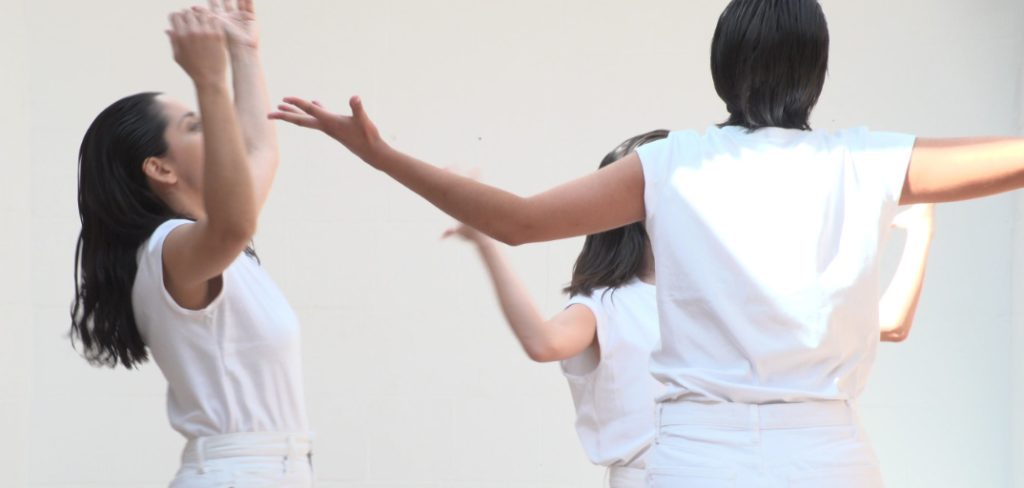
Through the story of the Greek myth of Orpheus, her choreo-operatic research pulls our focus to listening, proximity and power in a beautifully striking and delicate manner. The all-women cast shared the work in August 2022 at Lake Studios, just outside Berlin’s city center. Minimalist and raw, Amaya’s work offers a radical reconfiguration of opera, both politically and aesthetically. I was staying at Lake Studios at the same time that Sasha was developing the piece with her team, and sent her some questions about the work.
N: How did you come to work with opera as a performative medium and what do you think is valuable or potentially transformative about it?
S: One of the things that I find incredibly powerful about opera is its resonance in the body of the listener. Listening to live music is an incredibly physical experience. I grew up studying music, and had the opportunity to attend rehearsals up close, and, working with singers and musicians, rehearsals can be very proximate. I remember after the first piece I directed, someone told me that they really loved the way I positioned the singers to sing directly at them! Later, I realized I had created a very physically intense experience for the audience, something which I appreciate about sound very much.
I draw on my musical and academic backgrounds preparing for a work, but the decisions I like to make are a blend of intellectual and sensual ones. There is a kind of heartbreaking power being close to sound. In recreating Orfeo, and using the architectural space that I chose – the small (for opera), hard-walled, and minimalist studio — it was a special opportunity to bring the audience into a totally rare, intimate, and intense space of relationality with the singers, the sound, and the story.
N: What drew you to Monteverdi’s “Orfeo”, and opera, specifically?
S: Monteverdi’s Orfeo, written in 1607, is the oldest regularly performed opera we have in our collective Euro-centric classical music canon. It has totally stunning music – I am a really big
Monteverdi fan – and some incredible musical passages. It is also a story of Greek myth, which many people know or can be brought up to speed on quickly. Like so many Greek myths, the story is problematic but rich; it touches on love, power, ambition, and agency, and features travels through the living and under-worlds.
N: Can you share some challenges and some joys you’ve experienced in working with a traditional or classical framework, such as opera?
S: Presenting operatic work is very challenging: it requires a huge level of skill and commitment from everyone involved, as well as a real sense of, and willingness to, work as a team: director, singers, costume, set – everything all together. It’s demanding and exciting and a little bit hectic.
As I am most regularly working in dance, and am very much a dancer, what intrigued me about this recreation was to create a type of choreo-operatic work, something which held both things together, equally, and used the strength of each when needed. It was also my interest to express some of the emotions of the work – particularly those of Euridice – like grief, suspension, and sense of being
adrift. In using choreography and music, I had multiple tools in which to retell and reframe the story of Orfeo and Euridice, which resulted in a work that is striking yet fragile, strong and ephemeral.
I really wanted to engage classical singers, ideally with some predilection for movement, for this work, because I was curious about what place there is or might be for classical technique in truly non-classical settings. That said, bringing classical singers into a choreo-opera is not a seamless transition. In doing so, I am asking them to take up not only technique from another discipline, but also its values. The belief that the transition from something more frontal, linear, and traditional to something more fragmented, sensuous, and abstract would still have value can be hard to believe in. When the audience arrived, the power of what we were doing became clear.
In the residency framework I set up three additional structural challenges in the planning process.
The first was to create operatic conditions outside a city centre and outside an operatic venue, which we did by hosting it at Lake Studios, somewhere that is known for dance, and is an intentional journey away from central Berlin.
The second was recreating the work with an all women cast. This was interesting to me in the ways that it allowed us to intervene in and subvert the usual narrative of the myth, while still working quite well musically.
The third, and one of the most important, directives was for me to create opportunities for directors who are racialized as BIPOC in the European, and German, opera scene. That includes creating opportunities for myself, as well as opportunities for others. This was one of the most challenging aspects because there are so incredibly few POC, and especially POC women, directors in opera – like really almost zero. We contacted so many institutions, and even when stating our explicit recruitment goals, we were answered with many recommendations of racialized as white, cis-male colleagues! In the end, we had a mixed team, that included some diversity, but not as much as we had hoped. This brought to my attention that there is much more need for targeted structural support in the German scene, both at educational and professional levels.
N: Do you have a secret agenda in making operas? If so, can you tell us?
S: I think my approach to wanting to work with and around opera is actually quite simple! There are just some incredible sounds, and it is really an exceptional experience to be — physical, somatically, mentally, emotionally — around such sound. I am particularly drawn to the warm tones, woody instruments, and improvisational flexibility of proto- and early operas – so that’s a very basic reason as to why I am drawn to opera.
On an intellectual level, there is so much to unpack in opera. There are a lot of problematic storylines, strange traditions, and warped perceptions. Handling an opera is like something that is beautiful but thorny. I don’t want to remove all the thorns per se, but I do want to point them out: that’s here, that’s there, this one here, well, we did remove that thorn, it was just too much!
The Greek myths are particularly interesting to me because they are still very much a part of our educational system – or at least they were for me – and are rooted in so much literature, film, and popular media, so to take the seed of many western ideas about power, value, and goodness, and examine it, and remake, it is so interesting and vital.
On a political level, opera has a complex relationship with the public, censorship, patronage, and the stage, and only one slice of this has somehow entered our popular narrative, where opera is something very expensive and elite. But for much of its history, that wasn’t the case at all. Opera is weird, full-on, difficult, and sometimes freaky. I think a portion of the German opera scene digs into this, but still somehow the discipline — especially when it involves classical singers as opposed to contemporary dancers singing — as a whole remains quite apart.
N: If this performance was a public sculpture, what would it be?
S: A smooth white asymmetrical shell.