Daria Iuriichuk, Milla Koistinen: Politics of Fatigue: Sweat, Plastic, and Breath — Stumbling, Persisting, Resisting Exhaustion
Elisa Frasson / Feb. 2026
Fatigue doesn’t arrive suddenly.
It builds, repeats, and settles into the body as a rhythm that must be carried.
What matters is not how far the body can go, but how long it can stay present.
Moving through pOOr Butt Zany by Daria Iuriichuk and SWEAT (anthem) by Milla Koistinen for the Dance On Ensemble means navigating two very different choreographic landscapes while engaging with distinct, yet deeply connected, ways of thinking about the body as a political space. Both works seem to grapple with the same underlying question: what can a body do today when it is tired, exposed, pushed to the edge of exhaustion, and yet expected to keep performing? Between failure and resistance, solitude and collectivity, these pieces explore what it means to continue moving, to expose oneself, to remain present. In Iuriichuk’s solo, the body appears as a fragmented, overloaded affective archive, caught between desire and failure, like scrolling Instagram late at night. In Koistinen’s work, the body becomes a site of collective resistance, able to transform fatigue into a shared rhythm. Between these poles opens a space of reflection that concerns not only dance but the material and symbolic conditions of performing today. In both works, the body is not an autonomous or neutral entity; it is a field of forces shaped by labour regimes, economies of desire, and expectations of visibility that define its possibilities for action. Between failure and resistance, between solitude and collectivity, these pieces frame dance as a practice of persistence.
pOOr Butt Zany opens as an overloaded, saturated scene. The space is filled with objects: inflatable plastics, toy animals, balloons turned into improvised swords—affective prosthetics. This accumulation is not decoration, but an extension of a corporeal and political condition. The balloons reflect light and produce sharp, artificial sounds: light, cheap, fragile, yet cumbersome. These objects touch, obstruct, and extend the body. Movement unfolds as if within an archive of images and affects already consumed. The opening soundscape—partly produced live by Iuriichuk—and the presence of childlike, artificial materials activated sonically create an ambiguous atmosphere, suspended between playfulness and unease. Iuriichuk enters wearing culottes, small-heeled commedia dell’arte shoes, a bustier, and socks: a figure blending erotic codes, vulnerability, and awkward humour. The erotic, grotesque, and infantile overlap without settling. Eroticism is not a promise of emancipation, but a dispositif producing visibility and exposure. Cultural iconographies and scripts generate visibility and vulnerability simultaneously. The reference to the Zanni of commedia dell’arte emerges not as a citation, but as survival: a ghost moving through the body. Historically a servant and migrant figure, the Zanni reappears as a contemporary precarious subject, a gig worker forced into fragmented performativity, constantly exposed to judgement and replaceability. A body at the service of others, required to be present without ever being enough. Movement is often minimal, restrained, interrupted. Rather than progressing, it halts, turns back, stumbles. The dramaturgy is dense and deliberately discontinuous: texts, images, and shadow play evoke Romantic atmospheres filtered through a pop, plastic aesthetic. Registers slide continuously—slapstick, autofiction, eroticism, psychological horror—and the body seems to perform not to assert itself, but to stay afloat. Irony creates friction rather than lightness: comic and pop elements don’t ease tension—they jam it, exposing the automatism of repeated gestures. Eroticism, far from pure agency, is already captured by cultural scripts, rendered repeatable, almost automatic. Movement remains reduced, restrained, interrupted—more likely to stumble than unfold. Voice and language are central. Texts, talking toys, and audience involvement—evoking bureaucratic spaces such as immigration offices—do not form a linear narrative but fragments of a broader discourse on identity and performativity, reinforcing a sense of unstable exposure. The interaction with the audience collapses the stage-auditorium divide without forming a true relationship, intensifying exposure. Even openly pop references—like a German version of a famous Raffaella Carrà song and the “dance of the butt”—are not celebratory. The eroticized body is both agent and object, potentially free yet trapped in near-caricature images. Irony reveals the forced repetition of codified gestures and signs. In this sense, pOOr Butt Zany emerges as a work about failure: not lack, but a strategy where failing means resisting expectations of coherence, efficiency, and desirability. The body performs even when the performance seems over, as if stopping were impossible. Failure becomes political: a form of negative resistance, jamming performative mechanisms and exposing contemporary performativity.

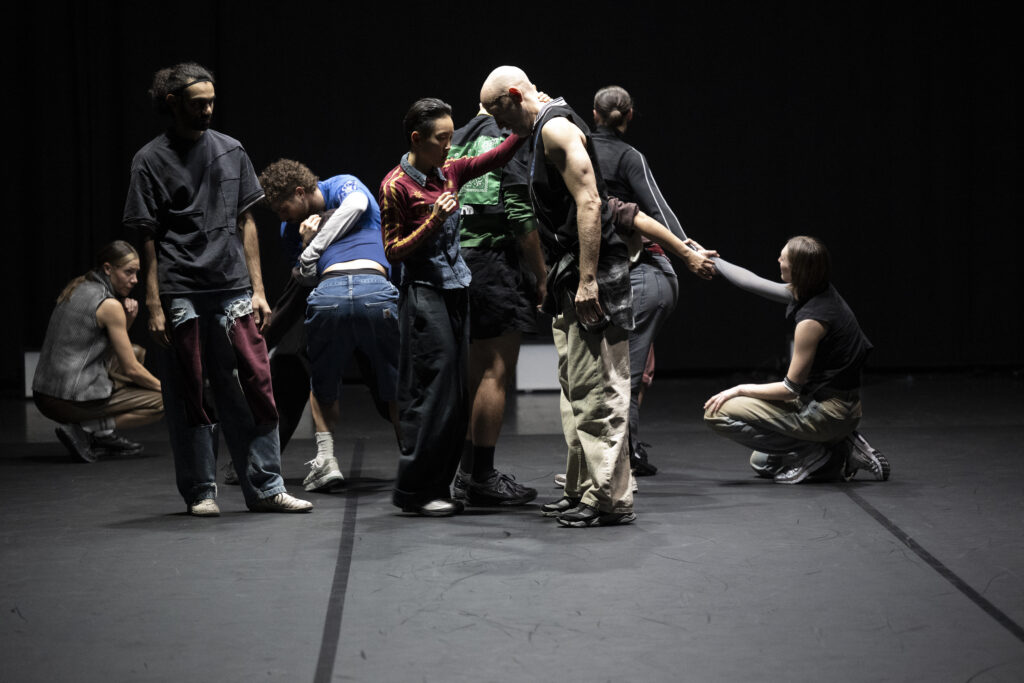
SWEAT (anthem) sits almost at the opposite extreme, formally, constructing the political body through explicit collectivity and focusing on shared resistance. Even with sports references—pop culture gestures like basketball—the body is neither isolated nor hyper-exposed, but embedded in a network of somatic relations that support its weight and redistribute effort. Ten performers walk along an oval trajectory to a steady, insistent electronic techno beat, establishing shared time and a common rhythm. Costumes—between sportswear/technical gear and casual clothing—and references to sports disciplines create a legible movement vocabulary. These cues, inscribed in clothing, movement quality, and repetition, evoke discipline, preparation, and endurance.
However, Koistinen’s choreography does not celebrate individual triumph or efficiency. Perseverance is situated, bound to duration, repetition, and staying within a shared structure. The composition is clear—lines, diagonals, rows—but within clarity emerges complexity: listening, reciprocal responsibility, and difference. Endurance here is sustained attention: choosing to stay present despite fatigue, vulnerability, and exhaustion. Choreography navigates tension between propulsion and suspension, acceleration and waiting, revealing resistance that cannot be separated from exposure to limits. Endurance becomes a political stance: continuing, maintaining relation within shared fatigue. Moments of suspension, especially crouches before bursts of speed, return repeatedly and close the piece in darkness, showing contained energy, charged waiting. Audible breathing, touch, and contact structure the work, signalling constant attention to others, responsibilities never purely individual. What emerges forcefully is the ensemble’s capacity to hold difference and cohesion together. Group dance preserves individuality while sustaining shared rhythm.
The multigenerational ensemble brings bodies with varied histories, ages, and experiences, legible in movement quality, effort management, and temporal relation. Energy is high, sometimes euphoric, yet never spectacularised: it arises from doing together, continuing despite everything. In this sense, SWEAT (anthem) functions truly as an anthem not by proclaiming a message, but by creating shared resistance. Endurance is not surpassing limits, but remaining within them: staying present together when the body asks for rest. The final kneeling/crouched position does not conclude, but settles in the space; darkness does not erase it, allowing the experience to linger in the spectator’s body.
Bringing pOOr Butt Zany and SWEAT (anthem) into dialogue reveals two modes of body politics and persistence. One is solitary, exposed, fragmented, resisting through failure—a body accumulating signs, objects, and images until nearly collapsing. The other is relational, embedded in a system that supports and tests—a collective body turning fatigue into alliance. Failure and resistance are not opposites, but strategies of performative survival. Within this tension, dance emerges as critical persistence: staying in motion in unstable conditions, transforming the body—tired, porous, fatigued—into a profoundly political act.