
Adam Man: Paradise
Beatrix Joyce / November 2025
Beatrix Joyce attended Adam Man’s solo exhibition, “Elsewhere I am you”, curated by Maj Smoszna at Galerie Wedding, and felt compelled to offer a response. This text is the inner monologue that unfolded in her as she witnessed the performance “PARADISE”, a dialogue between a two-channel video installation and live sound by invited cellist Judith Hamann.
– a naked body – lying in the foetal position in the soft curve of a ditch within a mountainous, barren landscape. – a person – their flesh glinting in the sun as it hits golden hour. – adam – just being there, existing there, amongst the bright green shrubbery that surrounds them.
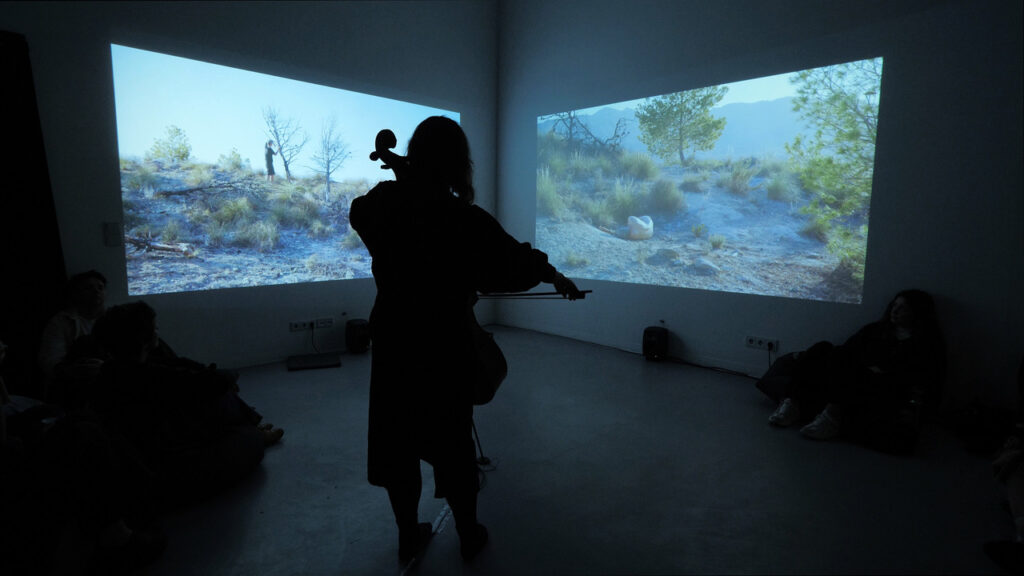
The light is beautiful and there is a breeze. The leaves waft from the flatness of the screen into the three-dimensionality of the space: it’s as if the wind from this cinematic landscape is breathed into the cello, played live for us by Judith Hamann. She is accompanied by bassy rumbles and the two bodies – the two versions of Adam – move across the walls and flow through her notes, her fingers, her body and the body of her instrument.
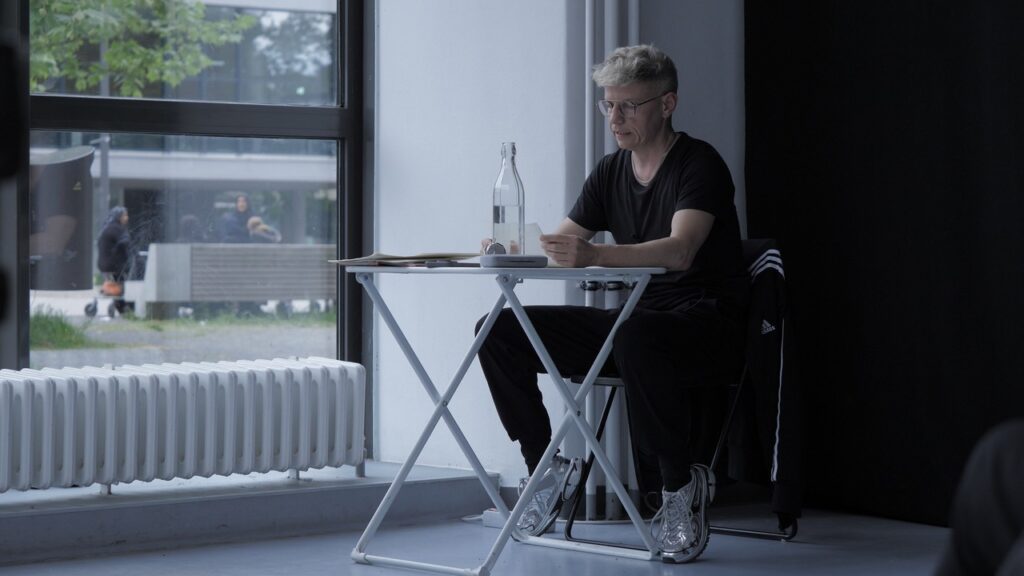
Is it a coincidence, that her instrument, the cello, is as close as it gets to the human voice? A voice that is a sequential partner in the piece, a B-side to the A-side we just heard in the other room: Adam reading from their writings they had composed every afternoon between 3pm and 4pm at the gallery. They wrote up their observations, faithful to their view and refreshingly plain, occasionally intercut with their personal musings on what they had witnessed and how it had changed the way they observed, felt and sensed their environment. “Was ist der Unterschied zwischen beobachten und schauen?“
The window-wall – a cinematic framing of the world outside – prompted me to imagine myself, my body, walking out onto the square and joining the scene. I fantasised about what I would do, how I would move, where I would position myself… How would this strange position of power – of knowing there was an audience behind the glass – affect me? Would entering the scene make me a performer?
If so, my performance would rather not be needed, as every body on the square was already performing. Unbeknownst to these persons, the show was already happening, unfolding in public space. I wondered: perhaps a performer cannot exist, without the framing of the performance? An unspoken social consensus that we are all directing our gaze towards a specific event, be it guided or unguided (such as the unplanned movements of bodies in public space). Perhaps that is the makeup of a performance: a framing, a collective direction of attention, and – ostensibly – the body. The human body.
The curious human body. In Paradise, Adam picked up the dead trees they had found (or did they put them there?) in the mountainous landscape. It was an example of human intervention: whether cut down by humans or by natural means, the trees that belonged to this windy, deserted land had undoubtedly been affected by humans, even if only through particles in the air. In the age of the Anthropocene, we, humans, our traces are everywhere. Does Adam represent our destructive force, trying to repair the damage that has been done?
The dead trees don’t seem damaged though. They just are. They fall to the ground when Adam lets them go, with an anti-climactic thud. I almost wanted there to be no sound in the film’s underlying score (you could hear the trees being dragged on the ground) so I could pretend it was a place that existed only on film. But the place is real, and Adam is hanging out with the trees. Leaning on them. Balancing on them. They may be dead, but they make for interesting crutches. They offer Adam support. Comfort even? Regardless, Adam lets them go, and they fall to the ground, another anti-climactic end. Adam looks back at the landscape. It’s different now. It has changed. There’s no going back to what it was before. We are here. And we witnessed the whole thing. I felt involved, perhaps even implicated?
The lone body in the deserted landscape. The thought of the potential of this incredible solitude excites me. I am reminded of when I first saw an unfamiliar continent to me through an airplane window: I couldn’t believe it, I felt like I was flying over some alien territory and I wanted to discover all of it, go everywhere, meet every plant, every tree, every stone… I imagine a mini-Adam, from the airplane window, doing just that: exploring the wilderness, moving through the landscape, simply with the body, through the body – and its framing. Thank you for bringing your body to us Adam, and with it, paradise.