
Asya Ashman: The Anthem of Haunted Eurodance Club
Dealing with ghosts of the past visions of the future, Ashman invites us to a haunted eurodance club, where failed hopes now attack us with a crooked smile. On Asya Ashman’s “THE ANTHEM”, premiered on February 25-26 and March 1 2026, Ballhaus Prinzenallee, Berlin.
Daria Iuriichuk / April 2026
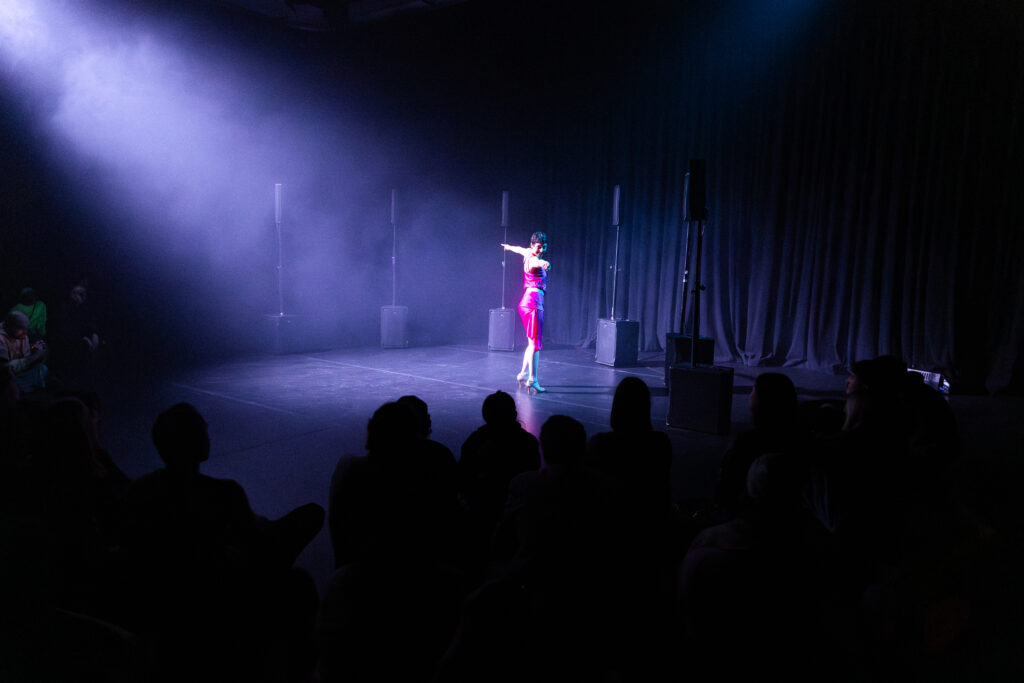
photo: Marina Merkulova
A muscular figure on high heels, in a pink satin dress, is surrounded by six speaker stacks arranged in a semicircle. Feet shoulder-width apart, arms raised above the head. The audience stands around forming another semicircle, creating an amphitheatre-like space. The sound evokes the intro of Darude’s “Sandstorm”, which is later revealed to be a forty-minute deconstructed version of the track created by Farhad Farzali, a sound designer of the show.
Released 26 years ago at the turn of the millennium, “Sandstorm,” the hit by Finnish DJ Darude, became an EDM (electronic dance music) anthem. It captured the mood of the “end of history”, proclaimed by Francis Fukuyama, a moment when liberal democracy seemed triumphant, major conflicts appeared to be fading, and the Internet promised to connect the entire world. No more borders, unity on the dancefloor! Well, at least in Europe: the euro currency and ideas of eurointegration fueled the anticipation of a joyful progressive future, enlightened by technology, music, and open borders. Departing from these almost retrofuturistic visions, Asya Ashman and her team question what has happened to them today. Darude’s Sandstorm has become a starting point for this artistic research.
The first scene, in which the dancer stands facing us with her back, with her arms moving in a waacking overhead roll, lasts quite a while. Soon, the feeling of unease increases: we notice that the track’s buildup is never released with a drop, the climactic moment when the bassline and drums are supposed to return to let go of the tension, but instead, the track shifts into an erratic, stumbling rhythm. The performer slowly turns to face the audience, maintaining the waacking movements. When she finally seems to notice the audience, she contorts her face into a predatory, smiling grimace and winks suddenly. Her movements become more aggressive, and she lunges forward towards the audience, menacing them.
The unease of an anticipated yet never-coming drop lends a haunting dimension to the scene. At the turn of the millennium, the utopian dreams were disturbed. From the 9/11 attacks to the 2008 global financial crisis, from Brexit to the new war in Europe, the hopes of entering a new era of a united and progressive world seemed to fade away. As Mark Fisher stated, the future has been cancelled, and expectations have deflated (Fisher, 2014), and the culture is looping back into the past in its ugliest, most distorted forms. “Take back control” (the Brexit motto), “Make America Great Again,” and “We can do it again” have replaced “Never again” in Russia; in the mottos of today’s right, the present seems trapped in revivals of all sorts. Instead of Fukuyama’s liberal utopia of the end of history, with global triumph of liberal democracy and market, we have instead arrived at what has been called the “cancellation of the future,” a condition in which the imagination of radically new alternatives is foreclosed and the present becomes dominated by repetitions of the past. Indeed, today’s world looks more like a dystopia with its AI-driven capitalism, defensive, backwards-looking politics and a gloomy suspense of the third world war. The unresolved momentum in the soundtrack feels accordingly, like a frustrated anticipation of future-oriented optimism. Stuck in a loop, the distorted Sandstorm in Ashman’s show is reminiscent of William Basinski’s 2002 album Disintegration Loops, recorded on self-erasing tapes. Dedicated to the victims of the 9/11 attacks, it marks the discontinuation of the optimistic epoch.
Suddenly, the performer disappears. Echoing Basinski’s self-erasing tapes, the performance disintegrates abruptly, collapsing into an awkward pause. In that gap, the audience is left alone and finally has a chance to see each other. Reworked version of Sandstorm is still playing, but now in a subtle, minimal section. After exchanging glances, the confused audience begins to walk around the hall and tap their feet. The groove is still there, and small dance circles start to form spontaneously. Gradually, people find their ways to fill the void. Some enjoy the music and dance, some travel through space watching the others. The atmosphere shifts from being awkward. This moment marks the peak of the performance’s disintegration, yet within that rupture, something new begins to take shape. Having left the stage, Ashman gives the audience a chance to reflect on themselves as a group. Does the rhythm bring us closer together? What kind of situative collective identity could we bear? Do we form a community of some sort? How do we situate ourselves towards the disintegrating body of the show? The scene invites us to imagine ourselves in relation to one another, and the bodily co-presence offers a chance to read this situated gathering as a form of political agency within the disintegrated world that we live in.
After a while, the performer reappears. First, she joins the audience in a shared dance without drawing much attention, but soon takes up more and more space. Intensifying waacking overhead hand rolls in different directions, she now resembles a statue of an ancient Greek athlete come to life. She picks up a small speaker, playing the same track but with a delay, and swings it at arm’s length, creating a spatial echo. The sound now acquires its own agency; it detaches from the stage, circulates through the crowd, and begins to organise space on its own terms. The promised future of seamless unity has long since fractured, yet another form of embodied togetherness briefly appears, held by the unstable choreography of listening together, the fragile possibility of gathering otherwise.
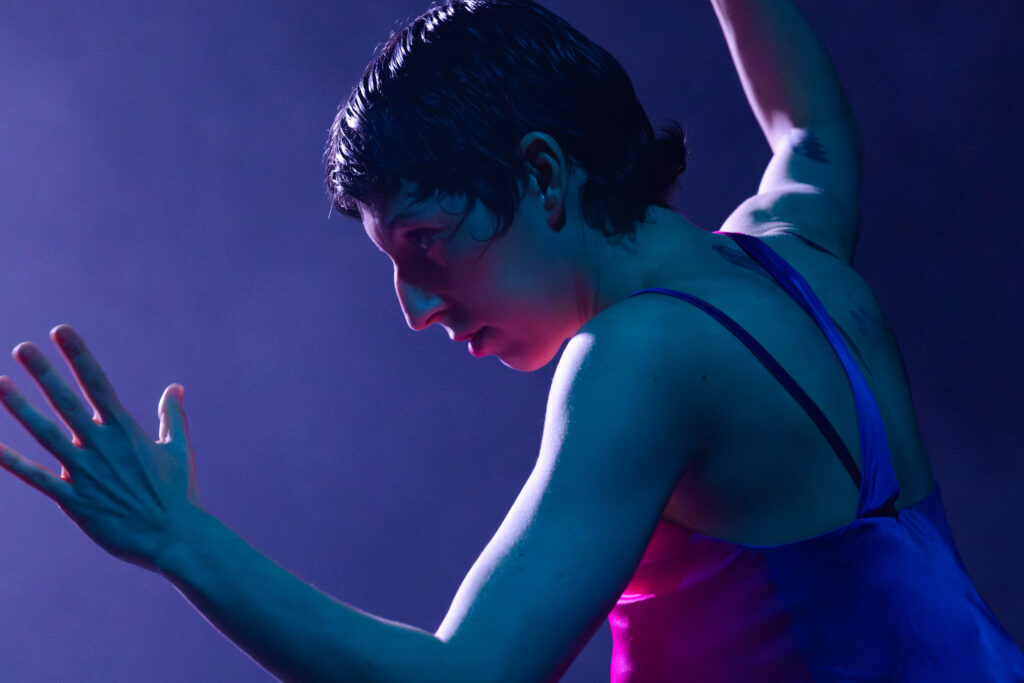
photo: Marina Merkulova