Inky Lee, Romuald Krężel : Guilty Pleasures and CODAS
On Thursday, 16.10.2025 Anuya Rane and Forough Fami attended Guilty Pleasures and CODAS at Tanzfabrik Berlin. The following text gathers their reflection on these two pieces — Forough writes about CODAS while Anuya reflects on Guilty Pleasures — followed by a brief conversation between them exploring the possible relations or common threads connecting the two pieces.
Guilty Pleasures by Romuald Krężel
What to begin with? Where to begin with? Are the two questions that I wrestle with as I start contemplating on the piece. Given the amount of carbon footprint I leave behind, for all reasons obvious; family, work etc. how much more can I be guilt-tripping?
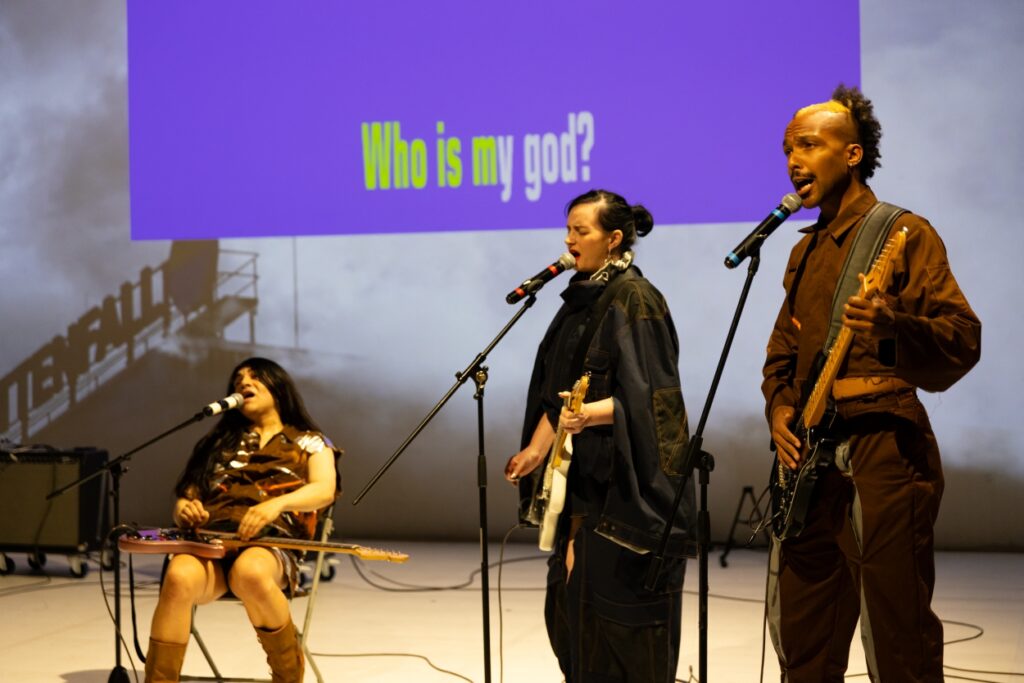
The questions that this piece throws out need no amplification. Yet there is amplification. Multiple amplifiers used in the performance take center stage, amplifying the music – the voice that is shouting disguised in the strumming of electric guitars. Presumably a smart way to make an already inflated matter bigger without having to provide direct solutions, which in any case is not necessarily the purpose of art.
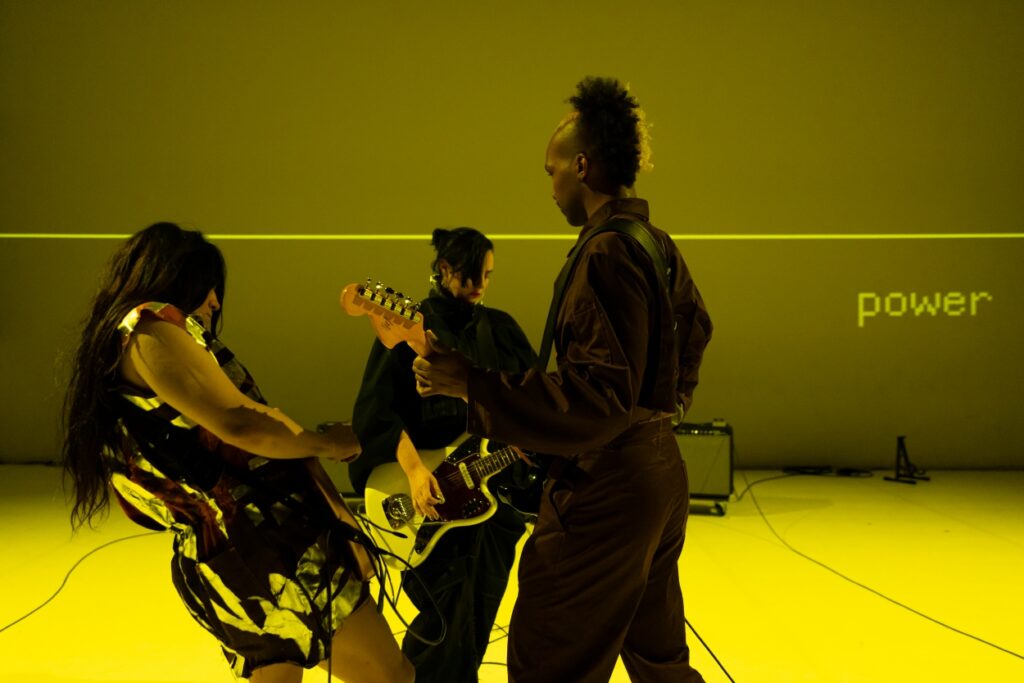
I am flirting with a few words that crowd my thoughts as I look back at this theatrical experience. A spontaneous reaction to what I witnessed: loud, exaggeration, music, alienation, disdain; although not necessarily in that order. Music here is the core and all encompassing. There is music but it is sound, it is noise, it is power, it is energy, quite literally electrical power/energy.
The opening of the performance is a stage set up with entangled wires lying around on the floor, amplifiers, electric guitars, a mic on a stand and an awareness message about saving energy projected on the rear wall. Though it begins (and lasts for some long minutes) with the three performers scrupulously sorting out the wires, it right away touches a musical note by their strumming on the guitars. Through the entire length of this rendering, into the bargain, lights are used in all colours and effects, including the stroboscopic effect All this is a clear indication of power and energy being at play. So where is the saving? Obviously, this is not about saving. Nothing can function fully without power in this world. So how can a statement concerning energy saving be made without using power?
Conceivably ‘exaggeration’ can be associated with this extravaganza. Maybe even ‘loud’, coupled with it. In this work Romuald Krężel attempts at confronting the ongoing debate on climate politics by granting electrical energy a material presence and power. This seemingly exaggerated approach is aimed at shedding light on the (mis)use of energy, resources, means of transportation and much more. Not running for the position of policy maker, this piece opens a safe space for social resonance that is different from a mere awareness about the subject matter.
The unambiguous structure, or in other words, composition of this work certainly strikes a chord with the spectators. The narratives by the three artists, in the form of songs and recitations are anecdotes that serve as material to relate with. When one of them tells his story as a worker, working on the site while his boss is on a business trip, “Travelling by plane because, well, he is the boss”, it is undoubtedly received as tongue-in-cheek. However, there are passages where all three performers put aside their guitars, the amplifiers, leave the mic and settle down on the chairs arranged at the side of the stage (which is, in fact, where they enter from at the beginning) that gets one thinking. Sometimes they sit still, at other times, someone vapes, someone sips from a cup, and someone is munching on snacks from eye-catching, fruit-shaped, fruit-colored boxes.
Alienation, as in the state, seems to me, closest to this attitude. The chaos is out there, around them and they sit untouched. I personally perceive a touch of disdain here; it is a situation of crisis, “But hey, why should I be concerned? I am anyway not the one initiating it”, is perhaps what their empty stares and shut mouths are suggesting. Isn’t this something that often echoes even in our minds? Throughout the performance and as the three stay seated on their chairs, graphics representing industrial structures, images of power plants, comments/quotes concerning climate urgency appear on the wall behind them. We, the audience, along with the artists, witness this and it affects us. It resonates with us. And yet there is alienation, lack of responsivity, that is to say immediate action (at this particular moment or in general).
Human beings thrive on some sort of social resonance. Aligned beliefs, feelings, actions shared in order to create a harmonized atmosphere. Climate urgency or emergency, however one may want to define it, is a matter that demands resonance. Hartmut Rosa’s “Idea of Resonance as a Sociological Concept” has preoccupied my mind for a while now. My understanding of resonance is, as he explains it, “a mode of relating to the world in which the subject feels touched, moved or addressed by the people, places, objects etc.” Art, literature, music can also have the same impact. However, Rosa particularly discusses resonance as being the “alienation’s other”. He writes:
“Resonance is not an echo – it does not mean to hear oneself amplified or to simply feel re-assured, but involves encounter with some real “other” that remains beyond our control, that speaks in its own voice or key different from ours, and therefore remains “alien” to us. Therefore, resonance certainly is not just consonance or harmony; quite the opposite, it requires difference and sometimes opposition and contradiction in order to enable real encounter.”
Nature is communicating with us, perhaps at its loudest. I am wondering if we as a society have maybe not turned a deaf ear to this call and are indulging in (the resonance of) Guilty Pleasures.
CODAS by Inky Lee and Hyemi Jo
Direct and deeply touching, CODAS with simplicity, sheds light on the experiences of Children of Deaf Adults (with migration backgrounds) which are often-overlooked in the world of hearing.
Through a playful, simple, yet profound use of dramaturgical elements, including autobiographical storytelling forms of narration, choreography and game structures, the piece highlights the experience of living in between the worlds of hearing and not-hearing.
Narrations
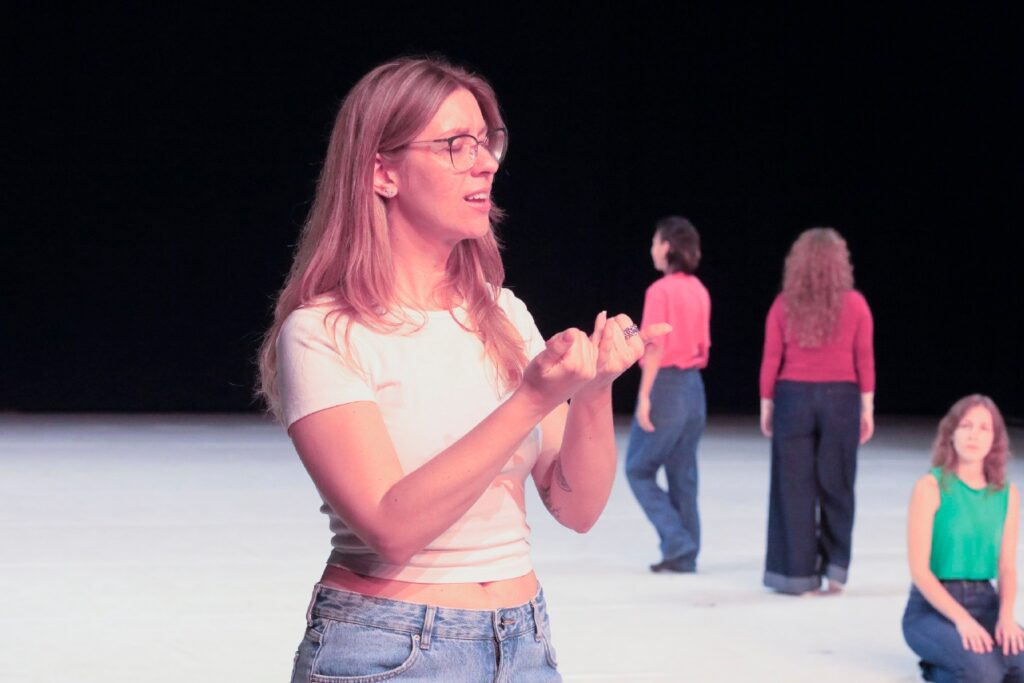
At the beginning of the piece, we are introduced to five narrating performers, three of whom are hearing Children of Deaf Adults, and two are deaf. Their introduction unfolds as the hearing performers share their experiences through a mix of spoken English, German, and German Sign Language (DGS), while the deaf performers communicate solely in DGS.
These narrations take us temporarily to the adventures, undertakings and wanderings in and between the worlds they are navigating between. They amplify CODAS’ reflections on the inherited responsibilities, required acts of care and dedication towards their deaf families, and their complex negotiations of identity and belonging within the worlds and communities of hearing and not hearing people around them.
The narrations took me (as a hearing audience member) closer to the reality of what it means to be constantly in between these two worlds. The insight they opened remains with me long after the performance ends.
The dance
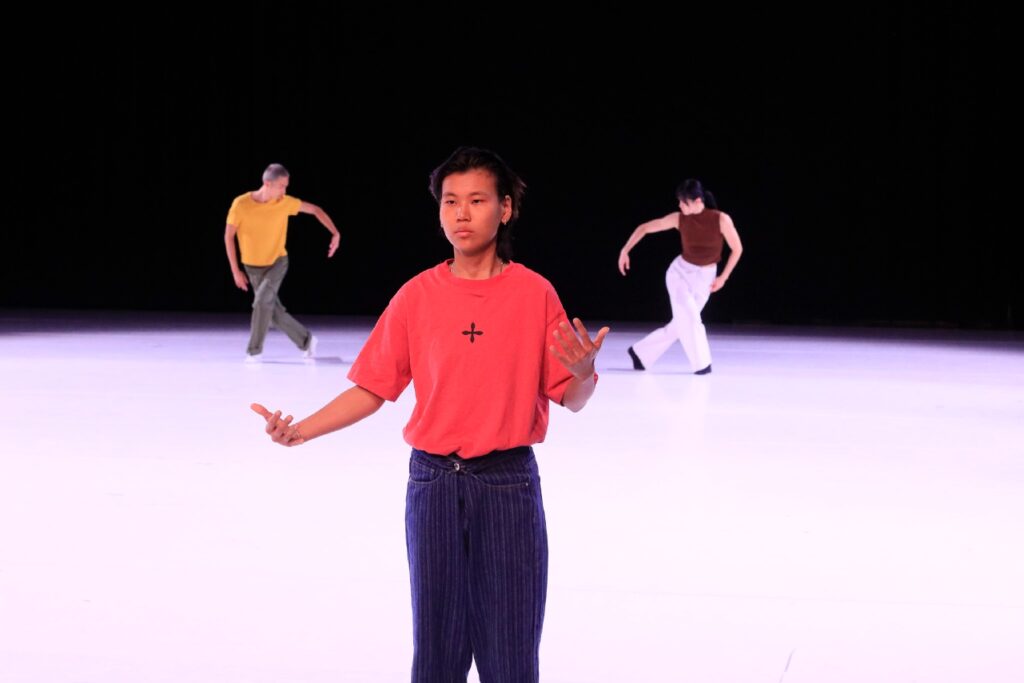
In contrast to the narrations, whose intimate affections traverse the personal boundaries shaped by hearing privileges, the choreographed movements of two other performers (dancers) on two opposite sides of the space largely remains restrained to me for some time through the show — symmetrical, ornamental, quiet and deliberately distanced. Although the dancers move in a precise continuous synchronicity (assumedly connected), their presence as a duet reinforces their structural detachment within the larger frame of the piece from the others.
Confronted with this detachment, I wonder how does this choreography listen to the context in which it is embedded? And how do the two dancers perceive and respond to each other? What allows their bodies to align in such precise synchronicity? As I moved through these thoughts, something on the stage began to open.
The games and the rhythms
The game form and the rhythms slowly emerge.
Rhythms emerge in communication, in the negotiation and transfer of meaning through games that communicate beyond their playfulness.
Rhythms emerge, not only acoustically, through the sound of the dancers’ expanding movements, their tapping and hopping, or the echoes of two pitches drawing closer together, but also visually, in the shifting lights and changing colours. Sounds become the colours and the colours viscerally turn into sounds.
The interconnected pulses of colour and sound ripple across the space, actively binding all the performers (the narrators and the dancers). It reinforces everyone’s movements to fall in a state of synchronicity within the vast, bare studio, charged with stories and experiences told around the topics of detachment. This sensitive use of light and sound design as amplifiers draws the worlds of hearing and non-hearing together and communicates with the performers and audience members with different levels of auditory perception.
Within the emotionally charged space of the stage, the symmetrical choreography suddenly reveals itself to me as a radical dramaturgical strategy. By purposefully invoking detachment, it mirrors and amplifies the thematic concerns articulated in the narrations.
In the end I respectfully read the piece as a metaphorical one, that in its poetical approach manages to remain profoundly connected to the concreteness of the reality.
Anuya and Forough’s casual exchange that followed the evening is an attempt at opening a shared space of thought.
How do each of the works relate to the title of the fold under which they are presented – Fold – Energie der Erzählungen?
– Anuya: Both of these pieces relate to the title Energie der Erzählungen as both tell stories. Accounts of personal experiences and collective experiences that automatically stimulate a cognitive reaction in the sense that one takes home the feelings, emotions evoked by the piece and analyzes and perhaps experiences a kind of transformation in one’s thought process. However, Guilty Pleasures for me had more to do with the energy of the telling than the stories themselves.
– Forough: I would like to note that in my understanding, to write about two works under the same title does not necessarily imply comparison between them. Ideally, it offers an additional lens or a way to discover the possible connections between the works and new relations or resonances that might otherwise remain unnoticed. For me the Energie der Erzählungen lies in the potential of storytelling to touch people, to move something within us, and perhaps, to spark change.
In that sense, I perceived CODAS as a whisper, strong, yet subtle and affecting, as an invitation to relate to matters from another perspective. Guilty Pleasures, on the other hand, to me feels more like charming and humorous crying out, a retelling of a story that insists on being heard.
To what extent do the works relate to each other? What are the points of convergence and divergence?
– Anuya: In my opinion, the works themselves do not literally relate to each other. However taking a closer look, one could trace a common thread; both deal with sound. Guilty Pleasures makes clear use of sound through music; both sung and instrumental along with speech, whereas CODAS uses sound as speech (spoken words), some musical passages at intervals and the sign language, which in its own way constitutes sound. The difference being that with Guilty Pleasures, sound lingers in the mind and CODAS sets in silence. Besides sound, they also have dance (as in movement) in common. Nonetheless neither of them affected me from that point of view directly.
– Forough: Adding to what Anuya mentioned, which I agree with, I see both works as culturally engaging with issues that demand attention and care. However, I read their distinct ways of addressing these issues as signifiers through which I interpret each piece’s intention. For me, this is precisely the point where the two works diverge.
Do you have any questions (not particularly expecting answers) to these performances?
To CODAS:
– Forough: On the night I saw the piece, the moment of applause was thrilling for me. I had not been aware of the common practice of applauding in sign when deaf performers or audience members are present, simply because I had never attended a performance involving deaf artists or spectators before. I of course chose to applaud in sign, and I was curious to see what the other hearing audience members would decide to do. Not a single clap was heard! Everyone‘s simultaneous decision was applauding through signing and foot stamping.
It may seem obvious or simple, yet it was striking for me to witness. I felt having watched the piece, a shared agreement had been collectively made by everyone (hearing-privileged or not) an expression of mutual understanding and respect. I find myself wondering how this moment took place on the other nights?
– Anuya: This piece could have continued for some more minutes – such was the strength of the extremely simple, yet profoundly moving narratives. It left me wondering, how many more stories the creators of the piece must have gathered and arrived at a final count?
To Guilty Pleasures:
– Forough: If and how did the piece include research into making its production more environmentally sustainable? And whether considerations such as material use and energy consumption were part of the creative process?
– Anuya: The costumes – design, color-scheme – were striking, suggesting something earthen and at the same time something heavy, metallic. Was that the intention or was it my mind forcefully trying to forge connections?