Sina Saberi: An Anatomy of Almost
Boda Keem / Feb. 2026
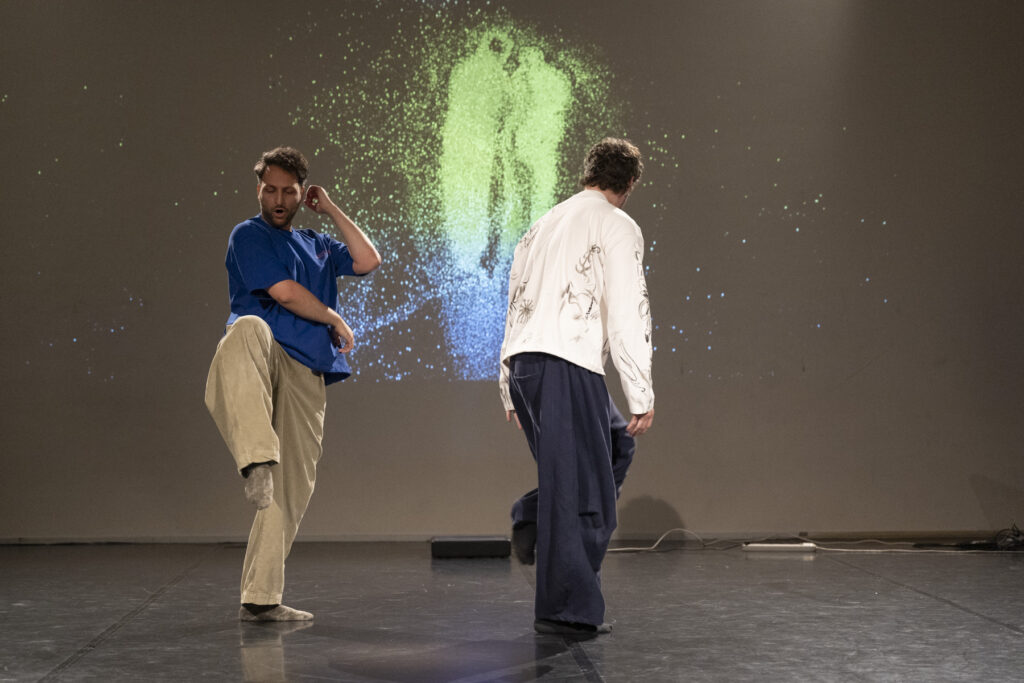
Two bodies occupy the diagonal as if grazing past one another, and a narrow beam of light—holding its breath—settles precisely at the center of the space. The open studio of Sina Saberi, selected for the Tanzfabrik fellowship program began like this, almost as if nothing were happening at all. As a monosyllabic sound tick, tick, tick touches the air and taps against the skin of the space, the two bodies repeatedly enter and exit the boundary of light without ever meeting or connecting. Their movements are composed of entirely different textures, and presence becomes legible through distance rather than contact. Tick, tick, tick. As the sound, falling like points, begins to fill the room, subtle traces surface on the wall behind the stage. From the contours of the dancers’ bodies, multiple dots disperse into the air. On this day, movement refuses to become a line; it appears before us as sensation prior to narrative, in a state not yet named.
Arriving once again in Berlin through the Tanzfabrik residency, Iranian choreographer Sina Saberi (او) has pursued a practice that traverses the boundaries between body, image, and literature, examining how individual sensibility becomes entangled with social structures. His latest interdisciplinary performance project, MARDOM, takes as its point of departure the enduring and still unresolved questions of pain and justice. How is pain inscribed on an individual body, and through what pathways does it extend into the collective body—or bodies? At the core of this inquiry lies a literary allegory Saberi has long held onto: Bani Adam, a poem written in the 13th century by the Iranian poet Saadi Shirazi.
Bani Adam—often translated as “Human beings are one body”—consists of only a few lines, yet its density has allowed it to endure across centuries. Saadi describes humans not as separate entities, but as limbs branching from a single body. The idea that when one part suffers, the rest cannot remain untouched is less a moral exhortation than an ontological declaration. The pain of the other resonates as a sensation at the very ends of one’s own nerves—a radical identification. Even now, as bodies across the world are severed by borders, placed upon unnamed frontlines, and repeatedly consumed between the languages of hatred and the long-drawn lines of division, this metaphor reveals itself not as poetry alone but as an anatomy of the present. When a sentence born in literature begins to breathe again within contemporary bodies, MARDOM becomes less a representation of pain than an inquiry into the conditions under which pain emerges. At the same time, the audience is positioned as a witness.
If Bani Adam were to be read through the body, it would begin with imagining the human as a single muscle, a single breath, a single joint. Onstage, the two bodies move like points that remain close yet never touch. Saberi’s movement begins with tapping, twisting, and clapping—gestures informed by his ongoing research into the EMDR method. While the team has shared extensive conversations around the notion of pain, Saberi explicitly resists reproducing it onstage.
This decision—to approach a universally shared concept without anchoring it in personal narrative and instead adopting a mode of non-representation—marks a refined point of departure. Saadi’s idea of solidarity is thus reinterpreted through the lens of dance: as a flow of energy, a network of bodies, and the sensory traces exchanged in space. Human connection here is not metaphorical but corporeal—bodies transmit, resonate, and affect one another through invisible pathways.
In Saberi’s performance, the poem does not explain collectivity; it structures movement. Though physical distance remains, what emerges is not isolation but a connected motion—a wave in which pain begins at a single point and spreads across the group, evoking the sensation of one larger body rather than many separate ones.
On the screen, the silhouettes of two dancers appear, and along their contours, fine dots begin to emerge. The particles disperse into the air, sketching the boundaries of the body before slipping beyond them. Dots appear and disappear, overlap and drift apart. Visual artist Mina Mohseni designed these particles so that even when the two bodies onstage do not touch, the dots emanating from their silhouettes pass through and overlap one another, as if meeting in an invisible atmosphere. The bodies onstage and the bodies on screen share the same origin, yet follow different temporalities and logics—similar but not identical, two bodies and two realities.
The dots flowing from the silhouettes become dust drifting with movement, and then, at a certain moment, expand into a galaxy filling the entire screen. Gradually, they move away from the recognizable shape of dancing bodies, forming a collective of their own. This organic cluster disperses, then collapses like a waterfall under an unseen two-dimensional gravity, tightening and loosening repeatedly as it generates its own density.
A decisive shift arrives with a card game. The two bodies step out of their roles as performers and move toward a deck of cards placed at the edge of the stage. As they draw cards at random, their eyes flicker with curiosity—and the audience’s gaze flickers with them. Crossing the line of the stage once more, their bodies no longer remain receptive vessels for pain; they become pain itself. Playful yet meticulous, with cold expressions and flashing eyes, the performers suggest that the fate casting pain does not wear a single face.
After the cards are drawn, the bodies move beyond their former selves, crossing standards of right and wrong, oscillating between the personal and the communal, shifting between being recipients of pain and agents of it. The screen behind the stage undergoes its own transformation. Through a 360-degree rotation, points become short lines; lines gain direction and form surfaces. Dimensions and gravity emerge, and a momentum of their own is generated. This momentum grows and takes shape until it transforms into a massive presence—cute and spooky like a caricature from afar, yet for those closest to its essence, an inescapable elephant in the room. The moment arrives when the duet give way to a trio.
I look forward to the completion of this work. What form might an anatomy of beings who are separated, yet never isolated, finally take? What kinds of faces will we carry within it—and which faces will we be able to accept? Sina Saberi’s dance quietly, yet unmistakably, affirms the truth spoken by that ancient poem, translating it into the space of today, into the bodies of now.
As a token for the readers : a short text of mine, written after stepping out of Sina’s open showcase. May it become a small breathing—for bodies in pain, or for those who find themselves looking at pain from nearby:
Again, someone’s pain
flickers at the edge of the screen.
A single dot — untouched.
yet the dot stretches into a line,
the line gathers into an unseen plane,
and the plane extends
all the way
to the ground beneath our feet.
Suffering, yet not belonging to this body
is pinned to coordinates
tilted
At a slightly different angle
on the same blueprint.
Furiously outnumbering dots,
we give up counting them.
in the plane of giving up,
a galaxy appears.
Pain sparkles,
clusters with itself,
turns into lines,
overlapping,
slipping.
One dot flickers
near my ankle.
One line brushes
against your shadow.
It is only this:
we missed
the moment
to step aside,
This burning star,
does not choose
which body
it becomes.