WILD ACCESS, Beatrix Joyce: Allow the darkness to be part of the experience
About the showing of “GLADE” by choreographer Beatrix Joyce
presented on 9th of October 2025 – Tanzfabrik Studio, Grüntaler Straße, Berlin.
by Lea Pischke
It started with rain. Not with the type of rain that soaks the collar of your coat and makes your face moist, but with a rain that tinkles in your ears, that gently crackles away and lets you enter a soft stupor. We are outside, we hear rain, yet, we don’t get wet.
“We”, that is fifteen people who have been invited to attend the general rehearsal of the performance “GLADE” by choreographer Beatrix Joyce, in a neighbourhood north of Berlin’s city centre, Gesundbrunnen.
It’s half past six in the evening on a Thursday: the city’s rush hour has turned the streets into busy thoroughfares: a woman is walking towards the main street at a brisk pace, chatting into her mobile phone oblivious of her own raised voice, two children zoom past on an electric scooter, standing behind the handlebars like two babyfoot figures, cars pile up in front of red traffic lights, prams are being pushed, restaurants open, dog walkers follow their leashed pets on their sniffing tours. It is getting dark, street lights slowly light up.
Each member of the invited group receives a pair of headphones and is instructed to follow the choreographer who is holding an emitter box in her hand like a precious stone. A small congregation of bobbing heads with flashy green and blue headphone lights forms and starts making its way to a small park a couple of metres away from Tanzfabrik’s residency studio on Grüntaler Straße.
We are now at the first of the many stops or sites that “GLADE” consists of: the huge silver hemisphere in the park, the path to the playground, the playground itself, the street, the residency studio windows.
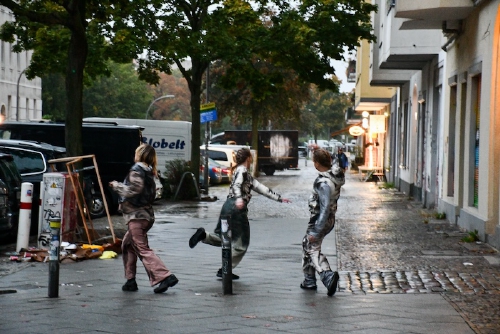
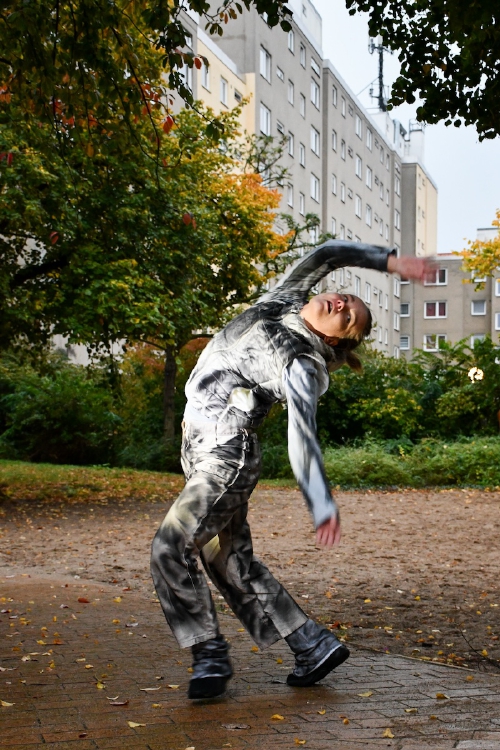
Three performers dressed in shades of grey, jumper, trousers and trainers, equipped with long-shot power torches, lead the group.
We arrive at the first site: The performers rest on the park’s big silver hemisphere that most probably serves as a fountain during summer time, one elbow propped up. The audience gathers around them, showered by the composition of electric crackle oozing out of the headphones.
This doesn’t go unwitnessed. A group of about six youngsters, aged between twelve and fifteen, all dressed in the popular neighbourhood attire – black shiney jacket, black jeans, black shoes, neatly parted, gelled hair – is surprised by the visit.
Moving about like wing-flapping pigeons abruptly disturbed in their business, they do not immediately know which reaction to put on: mark territory, ridicule the performers, shout?
They settle for friendly curiosity with one teenager opting for a quick cameo appearance in the performance, perfectly blending into the trio with remarkable accuracy.
The performers continue their walk, they use torches to draw the spectators’ attention to aspects of the environment: a leaf on the ground captured by a light cone, shadow play of a tree’s canopy on a house wall, shadow play of the performers themselves.
The audience follows and watches close by, sharing the same environment as the performers all the while being off-set from the hustle and bustle of everyday street life thanks to the different soundscapes coming through the headphones.
Encounters with the unknown
When performing in public space, there’s always the question of contingency, of the unknown. The street has its behavioural codes which are being disrupted by those who simply decide to not walk the dog, who do not push the pram or beg for money.
Those who just move for the sake of moving are alien to the street, yet, by being on the street, they forcibly become part of the street. And the collision of these two worlds make for that particular contingency: how will passers-by react? How will this other way of being in the world – dancing, performing – sit in a world which is not initially designed for it?
Public space performances always have to negotiate their relationship to that “other performance” that’s happening at the same time: street life.
Public space performances are rooted in the history of performing arts and carry their codes of a black box theatre over to a place where such codes are either unknown or not easy to decipher by those on the street, since they tend to be very busy with responding to other codes, e.g., avoiding collision with other pedestrians, managing the pavement curb with a pram, etc.
The rooting in black-box-behaviour very much comes from the audience itself: those who attend a public space performance are most likely people who have attended “private space” performances in the past, i.e., at a theatre, a dance house, or a gallery. They are familiar with the codes of the black box and juggle them along with the code of the street.
Even though the performers are on an entirely different mission than their audience, they do unwittingly join forces in tackling these contingencies of street life together with the audience. In the black box, audience and performers are spatially separated, here they are not: they are united in public space, united by the sense of being somewhat alien to the happenings of street life.
However, this only pertains to the invited, the “inducted” audience. But what about the spontaneous audience? The ones who have been recruited on the fly, who decide to steer off the usual path they tend to take with their dog on a Thursday afternoon, or who stop their phone call to watch what’s happening?
Such audience might not come equipped with the knowledge and readiness to transplant black box behaviour (watching intently at a respectful distance and clapping at the end) to the street. And that is where the uniqueness and beauty of public space performances lie: the encounter.
The meeting between public space performers and spontaneous audiences is in itself an event. Its unfolding is factored in by every choreographer creating for public space, but not everything can be predicted down to the last space after the comma. The performers will have to be ready to improvise and to diverge from the script in order to eventually come back to it.
That is what performer Michela Filzi does when she is joined by a teenager who leans right in front of her, imitating her elbow position: she smiles. With her smile she doesn’t judge the teenager, she lets him do what he is doing in a friendly and sympathetic manner. She knows that this is the spot where the teenager hangs out with his friends. She knows that she is a temporary visitor and might be considered an intruder. She doesn’t impose herself, on the contrary, she shares the space with him.
The teenager notices the benevolence, he smiles, too, a bit awkwardly, the audience smiles back, someone laughs, but not out of ridicule, out of sympathy. He finishes his little pop-up performance and joins his mates again. “GLADE” continues.
Ex vitro – when the audience is the show behind glass panes
One particular section of “GLADE” boggled my mind and it took me some time to understand why. Towards the end of the performance, the wandering audience group was brought back inside Tanzfabrik’s residency studio and invited to take a seat on a set of rising stands oriented towards two big windows facing the street.
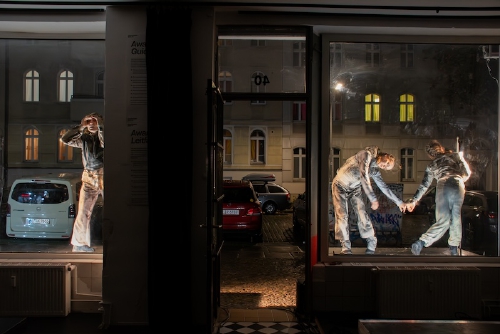
The performers stepped onto two small raised platforms which had been placed before each of the two shop windows, on the street side, so we, the audience sitting inside the studio, would be able to see them from head to toe.
Lights had been placed at the shop windows’ sides and right underneath the performers.
And here they were, reaching out to us, repeatedly collapsing into themselves, into each other, sometimes in one flush like a crashing high-rise, or limb by limb, deflated and rattled.
The sidelight made the performers’ eyeballs shimmer, their irises iridescent and translucent. Some pointed their index at the window and seemed to reach for the inside, others detached from the shop window altogether, to copy another performer’s movement further away, on the pavement, stretching our depth of vision back onto the pavement.
But that was not it. As we watched the performers perform, we also watched everything and everyone else “perform” on the street. The aforementioned electric roller straddled by two young teenage boys zoomed past at least three times. They realised that a performance was taking place. But what was most cunning was that they had also realised – unlike many other passers-by – that there was an audience somewhere hidden behind these windows. They were curious. And their curiosity turned them into performers themselves, unbeknown to them.
It was an “ex vitro” situation. From the inside, we watched a performance, with an added benefit of street life, from the outside, the street life watched us watching the performance, a performance that they could watch, too, from their side.
Who was watching whom? Who was decoration to whose performance? Who had the better vantage point? Who was audience, who was performing, and who was performing willingly and consciously?
What had we, the initial audience, become in the meantime? A serious-looking, orderly row of dark shadows, to complement the dancers’ movement? Or the freaks that the pedestrians realised had been watching them all along like seated awkward stalkers?
“In vitro” means “in the test tube”. It refers to scientific experiments being carried out under highly supervised, highly sanitised clinical conditions. Whatever the object of experimentation, it is located either in a test tube or on a laboratory dish, neatly isolated from any other, possibly intruding matters.
The end of “GLADE” made me wonder how it is possible to clinically isolate an audience of a public space performance, which always – as mentioned earlier – has to deal with the unforeseen, with the “pollination” of street life vagaries.
Even though Beatrix Joyce brought us back to the safe haven of the black box code by concluding her piece with the audience being seated in neat rows, we were still very much on display. We were in the test tube, discovered and observed by the pedestrians. And darkness didn’t protect us here, like it does in a theatre. On the contrary, it made the impression we left on those pedestrians even stronger, more eery.
In her introductory speech prior to the showing the choreographer advised: “Allow the darkness to be part of the experience”. And all I thought about was the performers’ strong torches, the patchy visibility of their limbs, the moiré effect of their costumes in the wavering light. Never did I consider my own darkness, my role as the “near invisible audience member”, sitting upright like a monument behind a shop window, to be aesthetically enjoyed by a neighbour walking their dog on a Thursday evening.