
Milla Koistinen: All or nothing
Beatrix Joyce / November 2025
Is performance a form of endurance? Beatrix Joyce interviews Milla Koistinen on her recent solo “GRIT (for what it’s worth)”.
Sure, we want to win, we want to finish, we want to do our best, we want to find our limit, we want to make people proud. All of that. But none of it quite explains it. It’s an unfathomable urge, a deep, primal call, to be out there, to stand facing oblivion, and to come through to the other side.
Adharanand Finn – The Rise of the Ultra Runners, p. 321
This quote, taken from journalist Adharanand Finn’s exceptional account of ultra-marathon runners, speaks to us from the threshold of physical experience. Ultra-runners – deemed “a new species of athlete” – compete in extreme distance races of 100 km or over, often in harsh conditions or across unforgiving natural landscapes. Each time, they go further, they reach higher, they push harder, testing the limits of human endurance – with grit.
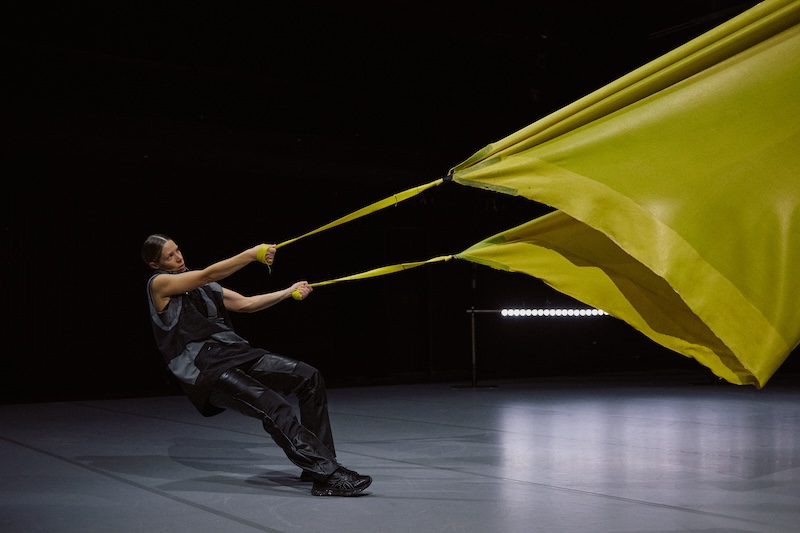
Milla Koistinen’s most recent solo examines exactly these qualities – determination, dedication, resilience – that can be found within sports and more broadly within the human spirit. Conjuring images on stage with her body, she brings to light our capacity to challenge our limits, to dive deeper into our bodies, and to cross thresholds we never even knew we could cross. Her onstage partner – a large-scale rubber sheet – acts as both a framework and a rival. In embodying the mental, physical and emotional states that motivate us to attempt superhuman feats, she activates our inner human drive that moves us through times of hardship.
Sure, we want to win, we want to finish, we want to do our best, we want to find our limit, we want to make people proud. All of that. But none of it quite explains it. It’s an unfathomable urge, a deep, primal call, to be out there, to stand facing oblivion, and to come through to the other side.
Adharanand Finn – The Rise of the Ultra Runners, p. 321
After seeing her perform at Uferstudios, I had many questions for Milla, for which she had many answers. Here a few of them that came up during our conversation on GRIT (for what it’s worth).
B: Aside from the physical endurance we know from sports, we can also speak of a psychological form of endurance. Does this also play a part in your artistic work?
M: Yes. With the current crises, it feels like we are in a different kind of place in our lifetime. It’s requiring a very different kind of stamina and mental resilience.
B: I find it interesting how you use the language of sports: stamina, resilience. It reminds me of athletes who are “in it to win it”; how in order to improve, they need to approach their training with an all-or-nothing mentality.
M: Exactly. During the research phase, I found myself particularly interested in athletes who had a deeper purpose beyond just winning. There was something more at stake. This brought a subtle – but important – political layer to the work.
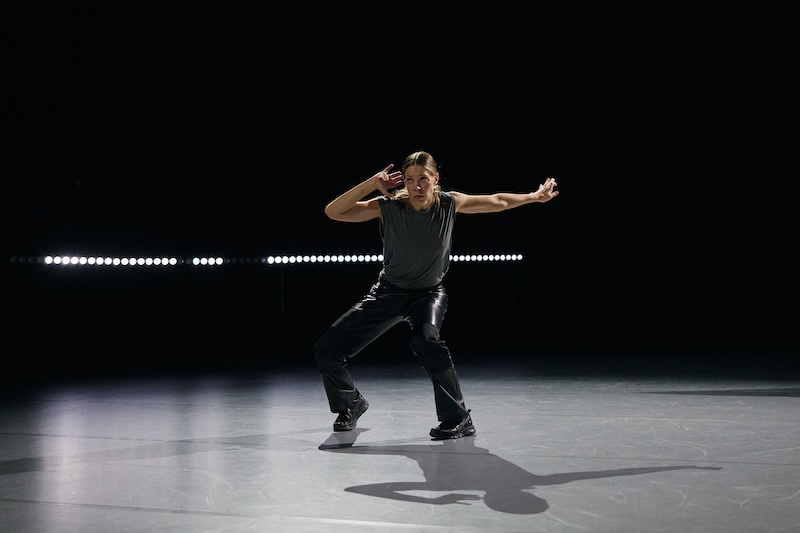
B: One thing that I find really interesting about your artistic practice is how you take stills and images from other domains – such as crowd dynamics, sports – and transform them into choreographic poses. The press image for GRIT shows this clearly: your body position almost exactly mimics that of a windsurfer. How did you work with poses this time, and what did they bring to your movement?
M: For this piece, I created a pool of precise reference images. Each time I move, I have a specific athlete in mind—including their facial expression. I focused more on facial muscles in this work, which gave the performance a clear, grounded presence. It’s not just about me; I’m channeling these athletes through their postures and movements. They’re with me on stage. I also watched many sports videos and documentaries to connect with their specific physicality and precision.
B: That’s really visible. Each sport shapes the body in a distinct way and is paired with a specific mindset: swimmers, sailors, runners, they each have their focus points. You embody these different athletes and yet, your body doesn’t change shape. Instead, you embody the essence of each sport. There’s a collective familiarity to it, too—people recognise these images because they’ve seen them in the media or while growing up.
M: Yes, and that’s part of the point. Sports are more universal than the arts, maybe because of the drive and competition, but also due to kinaesthetic empathy. Even if people don’t play sports, they’ve experienced similar movements at the gym or in school. The audience carries these bodily memories with them. They can recognise gestures and can relate to them – that helps shape how they read the work.
B: It makes the experience more immersive. It feels like we’re in it with you.
M: Yes, I asked myself: how can I play with empathy in performance? This was particularly challenging in this piece, because unlike Breathe or Magenta Haze, it had a frontal setup. So I asked: how can I reach people from this position? I didn’t want to just “perform” in the traditional sense. I wanted to relate differently—to be in a space mentally and emotionally where I wasn’t just showing something, but inviting the audience into it.
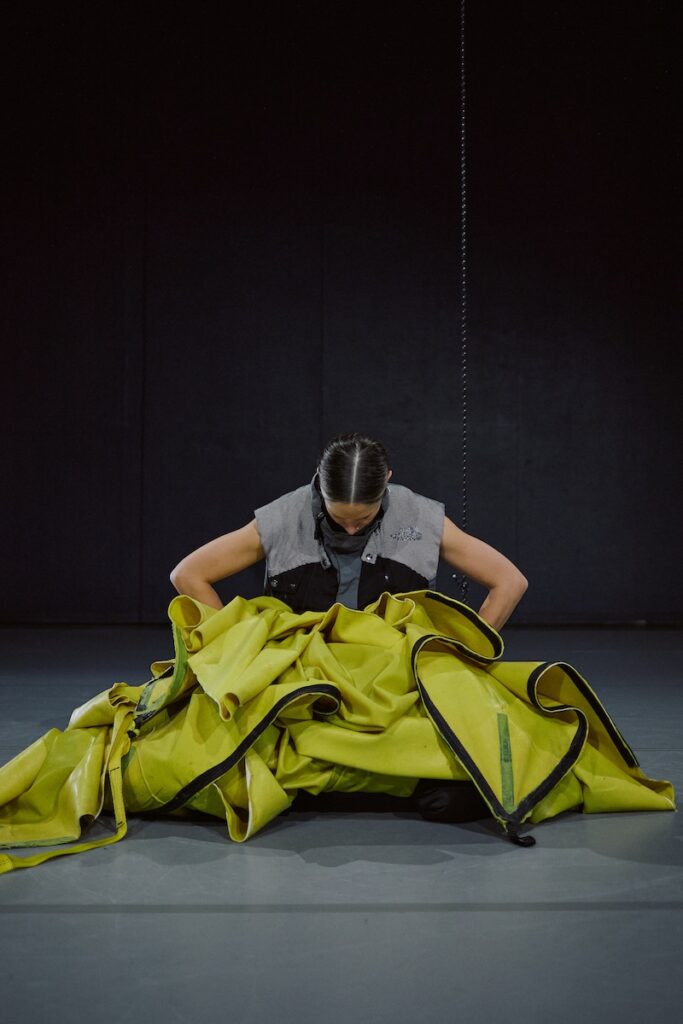
B: I also wanted to ask about the rubber sheet. It feels like more than a prop, rather, it’s an object with which you are negotiating a relationship. Your approach to it feels quite matter-of-fact, in contrast to the highly symbolic movement in the choreography. Your body knows exactly what it’s doing—like an athlete—but the fabric is awkward and uncooperative. And although you’re the one manipulating it, it seems you’re not always in control – rather, you lean into it and listen to it. It resists, and you adapt. This brings tension, both in the sheet itself and in the dramaturgy. Was that deliberate?
M: Absolutely. I have to be very precise. If I move too casually, it becomes meaningless. If I overperform, it feels too sacred or dramatic. This was also a conversation I had with my collaborators in relation to the music, as it can easily become too dramatic. I wanted to create a charged space, in a subtle way —without the direct competition of sports, but with that same intensity. Like a 100-meter sprint on TV: there’s all this buildup and then it’s over in a couple of seconds. It’s rather anti-climactic. But that tension, that pressure, is something I often explore in my works. I haven’t worked out yet how to let it fully release. There are things that come to an end, but it’s never a full resolution.
B: It evokes a kind of superhuman drive, like batteries that are constantly on charge. Similarly, the text that you spoke at the end was quite charged – charged with a kind of “I’m going to do it anyway” – a dark – kind of energy. Where did the text come from?
M: The text is based on various interviews I conducted with athletes. Initially, I wanted to use a Bob Dylan piece about Woody Guthrie, but I couldn’t get permission. Dylan’s protest songs resonated with me in relation to this work, as they reflect how he was dealing with society at the time. So, I compiled fragments and composed them, so they fit the rhythm and set the tone for the piece. These 60s and 70s freedom songs give the work another layer, a political reference that holds weight and urgency.
B: And there is urgency now! There’s so much going on, within the social and political arenas. You have a voice, and you used it.
M: We created this work amid major funding cuts. I kept asking myself: what am I doing as an artist? Does it matter? What am I fighting for? It’s not about making political statements, but there’s an underlying message. It’s subtle, but it’s there if you look for it.
B: It came through strongly. That urgency, that sense of endurance: not just physically but as an artist surviving the times. That’s grit.
M: One thing I really appreciated in the process was the physical training. Lifting weights, counting reps: those tasks are so clear. It was refreshing compared to the sometimes laboriously ambiguous conceptual work of dramaturgy and creation. I once saw a retired footballer train with the intense focus of a 12-year-old boy. That commitment was inspiring. In the arts, we don’t tend to set clear goals, but maybe we should. It’s not always about how you feel—it’s about doing the work, with tunnel vision if needed.
B: That focus brings presence. It’s a different kind of awareness—a single-mindedness that contrasts with sensory states that draw on infinite listening. But both are valuable – and it’s a powerful tool, to be able to turn discipline and determination into artistic fuel.
M: Yes— and this is when my inner old-school trainer comes out, and says: “Yeah! Let’s do it!”
I wanted to create a charged space, in a subtle way —without the direct competition of sports, but with that same intensity. Like a 100-meter sprint on TV: there’s all this buildup and then it’s over in a couple of seconds. It’s rather anti-climactic. But that tension, that pressure, is something I often explore in my works.